Florida: Fins and Feathers
A waterfowler’s guide to the best cast-and-blast adventures in the Sunshine State
A waterfowler’s guide to the best cast-and-blast adventures in the Sunshine State



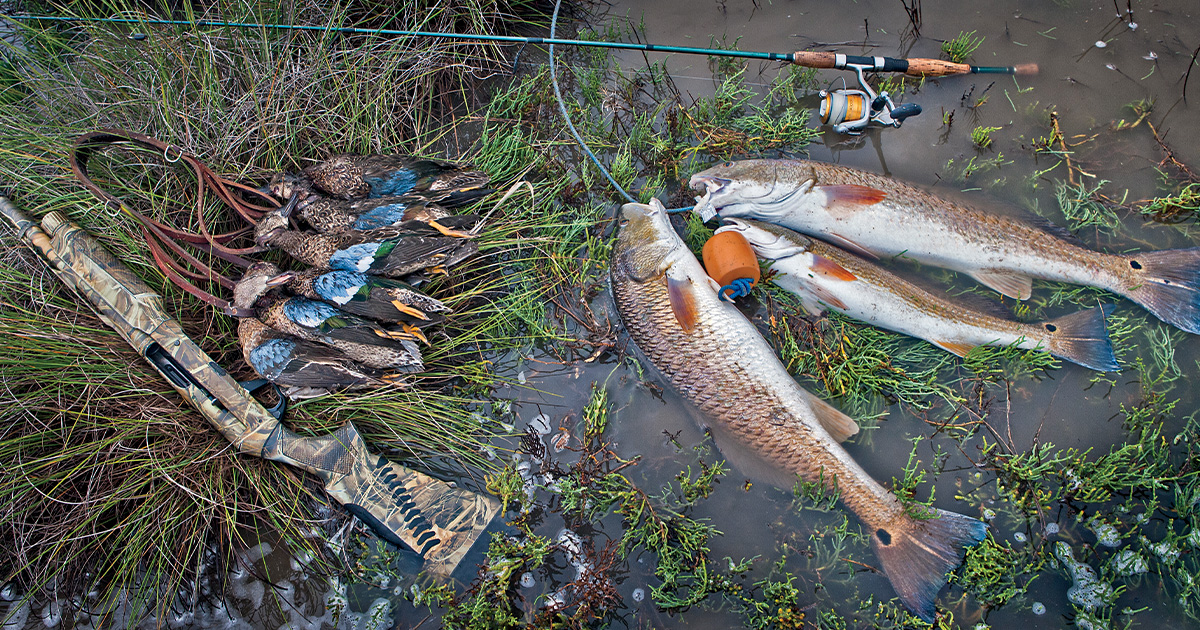
There is a long list of reasons to visit Florida—white sandy beaches, family-friendly theme parks, great seafood, and plenty of sunshine—yet many waterfowlers who vacation here overlook the state’s outstanding duck hunting opportunities. That’s a shame. Step away from the tourist attractions and beachside resorts, and you’ll find that Florida offers a whole world of waterfowl hunting adventures. Even better, you can easily combine a morning in the duck blind with world-class saltwater or freshwater fishing in the afternoon for a once-in-a-lifetime experience.
The following hot spots are only slivers of the Key lime pie when it comes to top-notch cast-and-blast trips, where you can strip off waders, throw on flip-flops, and start casting for trophy fish—all in the same day and often in the same location.
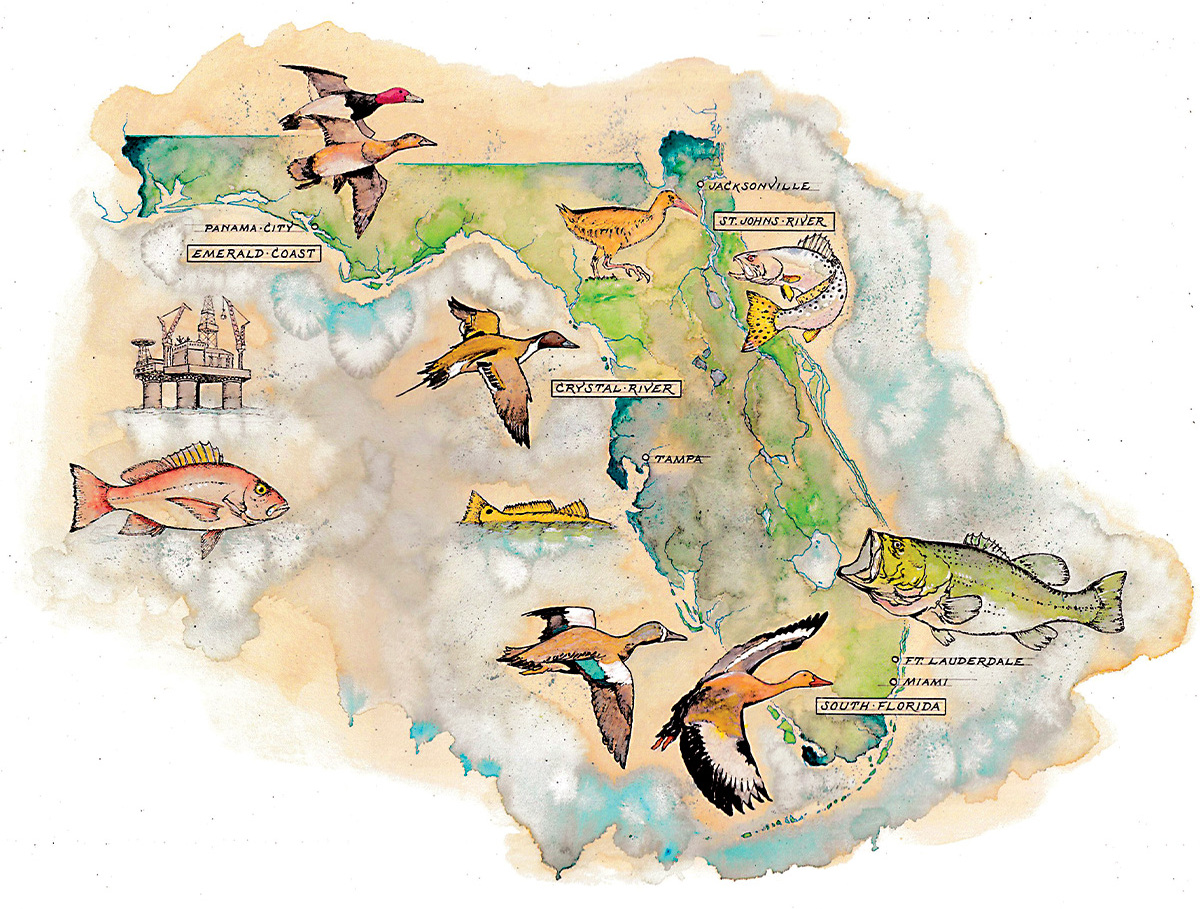
Florida’s unique geography, diverse habitats, and tropical climate provide a fascinating variety of options for the wingshooter who also wants to wet a line. The state’s saltwater and freshwater fishing is legendary, and lesser-known opportunities to hunt diving ducks, puddle ducks, whistling ducks, and even clapper rails will keep a shotgunner busy.
Famous for its beautiful beaches, the Florida Panhandle is a playground for millions of tourists each year. While summer is peak season for most visitors along Scenic Highway 30A, the winter months are the favorite time of year for Captain Travis Rolan, a Panama City native who is willing to share the details of his cast-and-blast trips along the Emerald Coast.
“We hunt everywhere from Panama City to Carrabelle,” Rolan says. “Most people don’t know there’s so much public access. We chase divers on the coast—redheads, bluebills, and buffleheads—but there are opportunities for some spectacular wood duck shoots if you go inland.”
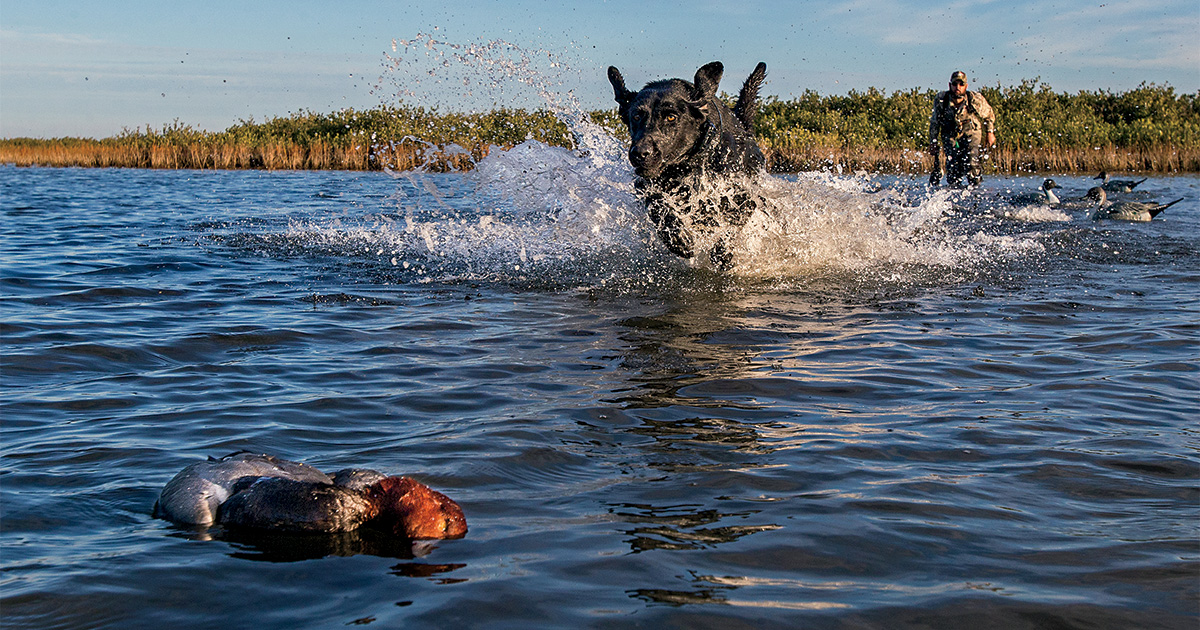
Rolan grew up in the area and spends lots of time on the water, so he knows where to find concentrations of diving ducks off islands and points. “I bring five to six palm fronds for each hunter, and we sit on dove stools, driving the palm fronds into the sand to create a blind. It’s easy hunting, and like most things around here, it’s pretty comfortable,” he laughs. “We typically shoot our redheads, and sometimes that’s it. Other days we can get full limits with bluebills, buffleheads, and an occasional stray golf course mallard. Then we pack up the guns and start looking for fish.”
If the weather cooperates and the seas are calm, Rolan heads out to offshore rigs for red snapper, one of the most sought-after sportfish in Florida. The state recently modified its red snapper season, which now overlaps with part of duck season.
“We can run about eight miles offshore and start fishing the rigs,” Rolan says. “If the wind kicks up and we can’t go offshore, we fish for redfish and speckled trout in the bays, which can be great this time of year. Either option makes for one heck of a day—shoot some ducks, then fish until dark. I’d do it every day if I could.”
The city of Crystal River is nestled among thousands of acres of federal lands and state wildlife management areas. An oasis of outdoor adventure north of Tampa, this area offers bucket-list opportunities for both duck hunters and anglers.
Captain Shawn Walker, owner of Salt River Outfitters, has been guiding in the area since 2008. “There can be pretty good numbers of diving ducks; you just have to find them,” Walker says. “We go out into the mangroves and islands and hunt the edges, hiding behind palm fronds. It makes for a relatively easy setup.”
Walker also hunts a handful of freshwater marshes along the coast, where ringnecks and wood ducks are the primary quarries, but most of his clients prefer to hunt divers on salt water. “It’s a unique style of hunting. The sandy bottom makes it easy to retrieve birds,” he says.
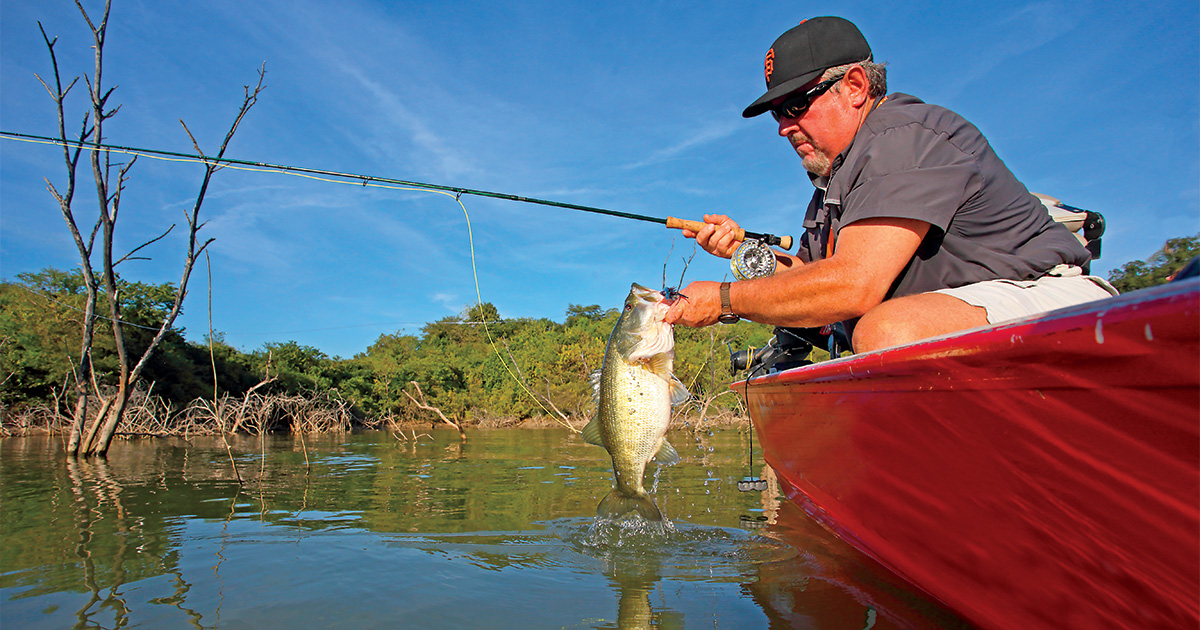
Florida’s nutrient-rich waters and warm temperatures allow largemouth bass to grow quickly, offering anglers opportunities to catch trophy-sized fish on a regular basis.
The Crystal River itself is known for tarpon fishing, but during duck season the best angling opportunities are for redfish in the mangroves. Unlike sight casting on the flats, this style of fishing is much more like bass fishing—on steroids. Flipping a live shrimp on a jig head into the mangroves, not knowing what might slurp it down, is as exciting as inshore fishing gets.
“We sometimes hunt in the morning and fish after the hunt, or we will fish first and then set up for an afternoon hunt,” Walker explains. “We cruise the mangroves and toss plastics or a jig head with a shrimp on it. There’s a wide variety of species you can catch, but we are targeting redfish. The biggest one I’ve caught was 48 inches. That was a good fish.”
Winding for 310 miles, the St. Johns River in northeast Florida is the longest river in the state, and it offers excellent fishing along its entire length. While portions of the river attract decent duck numbers, Rami Ashouri, an avid outdoorsman based in Jacksonville, has found another hunting opportunity when ducks are scarce—jump-shooting marsh hens, also known as clapper rails.
“Early in the season, the bluewings and greenwings are very difficult to track down. They are in and out of here so quick,” Ashouri says. “I have found that hunting marsh hens is a great alternative.”
Clapper rails are fairly large, measuring 14 to 16 inches tall with long legs that help them wade the shallow tidal flats. Ashouri push-poles through the marsh in his 17-foot Hell’s Bay Professional with one or two shooters positioned in the front of the boat. As the craft slowly glides through the spartina grass, the rails flush, providing an experience akin to upland bird hunting.
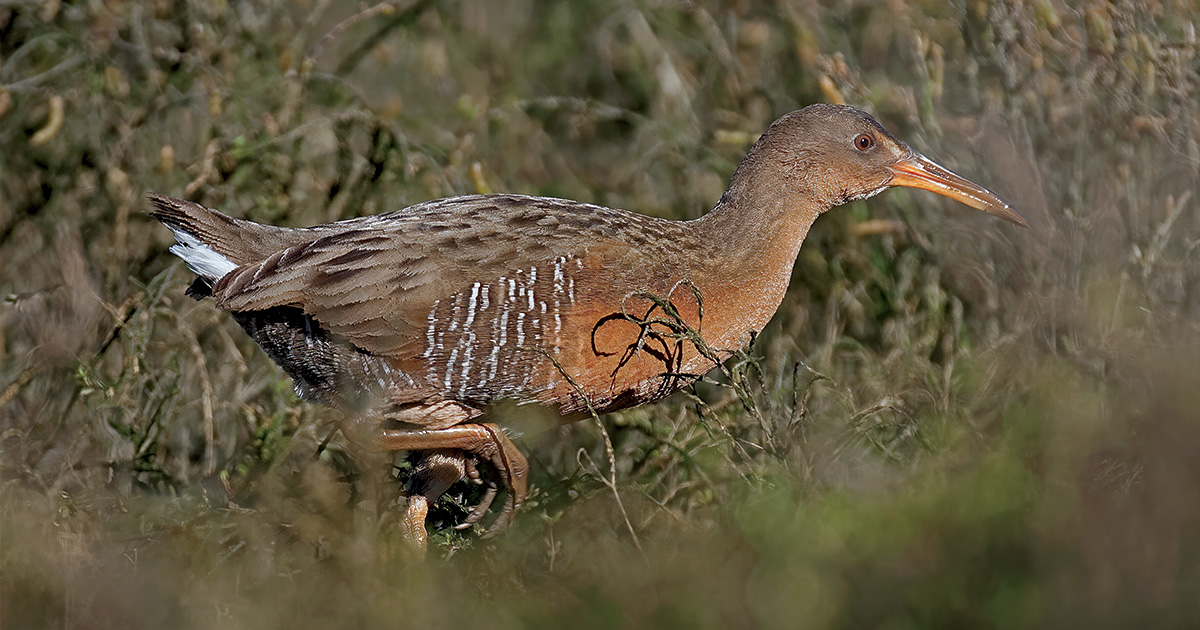
“It’s like quail hunting in a boat,” Ashouri explains. “The limit is 15 birds, and there are plenty of them, so it’s a pretty fast-paced hunt. Typically, we flush one or two birds at a time, but on occasion you can bump upwards of 20 birds.”
Of course, a visit to the St. Johns River wouldn’t be complete without wetting a line. World-class speckled trout, redfish, black drum, and even largemouth bass round out the most-targeted species, depending on the salinity level in the portion of the river that you are fishing.
“Our hunting isn’t based on time of day,” Ashouri says. “It centers around the tides. The marsh hens hide in the marsh grass, so when the tide comes up, that makes them a little easier to flush. I’ll spend the morning sight fishing tailing redfish as the tides go up, then hunt marsh hens on the peak. As the tide falls, we put the guns away and go back to the redfish.”
If you mention to locals in the Fort Lauderdale area that you drew a daily duck hunting permit on a Stormwater Treatment Area (STA), you’ll make some new friends in a hurry. South Florida’s STAs were designed to filter phosphorus and other nutrients from surface water flowing south into the Everglades. These wetland impoundments are connected by canals, and they are packed with submerged aquatic vegetation. Collectively spanning thousands of acres, STAs offer opportunities for duck hunting, fishing, and bird-watching. Hunting access is largely managed via an electronic draw system, although some walk-in hunting is also available.
Fort Lauderdale native Eric Leech has been hunting ducks in the area as long as he can remember. “We mainly hunt the STAs and surrounding wildlife management areas as well as the Flow Equalization Basin [FEB],” he says. “The A-1 FEB is just north of the STAs. All of these areas can have very good duck hunting, but it’s important to know how to hunt them.”
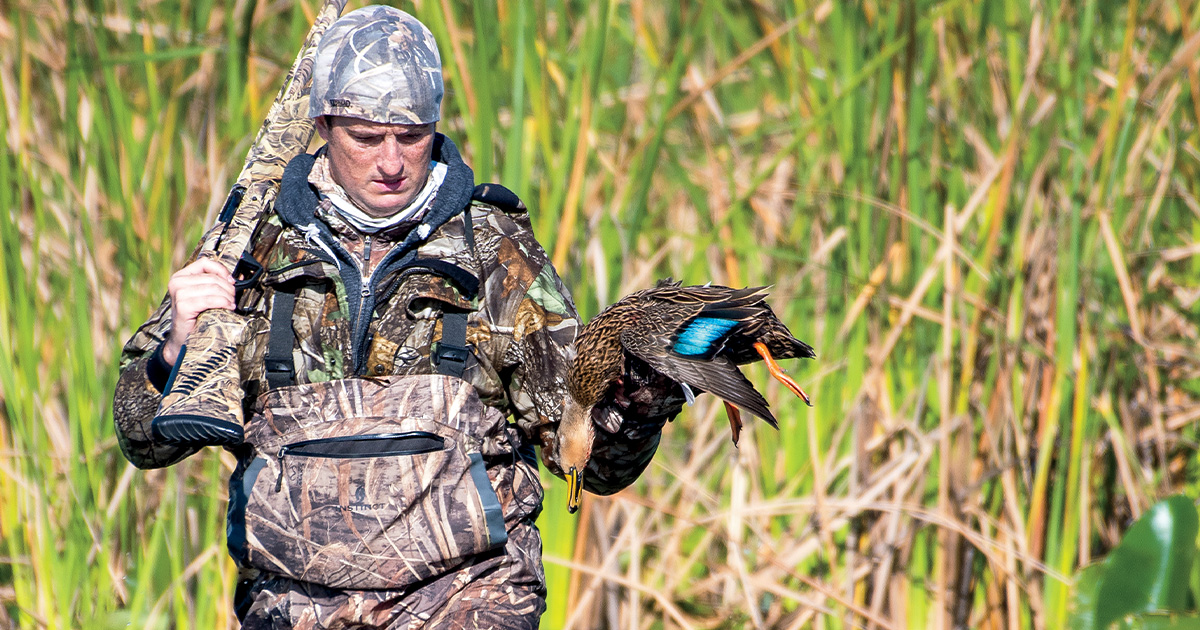
Coastal and freshwater wetlands throughout Florida provide opportunities to bag mottled ducks and other species that may not be available to hunters in other states.
Leech uses a kayak to paddle into the STAs, where dense stands of cattails and other marsh grasses provide plenty of cover in which to hide without a permanent blind. The big draw here is the diversity of waterfowl species. “We shoot wigeon, ringnecks, mottled ducks, teal, pintails, fulvous and black-bellied whistling ducks, and several other common species,” he says. “A lot of hunters come here looking to harvest birds in full plumage. I am often asked where you can harvest a mature drake bluewing, and I always tell them the STAs. Even our ringnecks and wigeon are beautiful.”
It’s no secret that Florida’s unique climate and aquatic habitats support world-class bass fishing, and the STAs offer some of the best opportunities the state has to offer. “Oh yeah, we bring fishing rods, and sometimes we will see huge bass rolling in the decoys or on the paddle in, especially in the A-1 FEB,” Leech says. “The water is deeper, you can use trolling motors, and while you can only hunt Friday through Sunday, you can fish every day. I’m talking trophy largemouths. It’s not unusual to catch seven-, eight-, nine-, or even 10-plus-pound fish. You can also get into peacock bass, snakeheads, and a wide range of other fish.”
Some of the best STAs for waterfowl hunting are located close to tourist meccas like Fort Lauderdale and even Miami Beach. It’s a testament to the diversity of habitats that are available throughout the state, and certainly something that shouldn’t be overlooked by duck hunters planning a visit.
“We had a day where we duck hunted and then bass fished after picking up decoys,” Leech recalls. “I caught two eight-pound bass, and we packed up and headed back to Fort Lauderdale. We went about a mile and a half offshore, and I caught a sailfish. That was a pretty good day.”
Book your visit now for DU’s 89th National Convention

DU volunteers, members, and staff will be coming from across North America for DU’s 89th National Convention in Tampa, Florida, May 27–30, 2026. The convention will celebrate two huge milestones—DU’s recent delivery of more than 1 million acres of conservation in a single year and the conclusion of the $3 billion Conservation for a Continent campaign, the largest conservation campaign in history.
The convention will be hosted at the JW Tampa Marriott and Tampa Marriott Water Street, two stunning properties complete with all the amenities and access to downtown district shopping, restaurants, and entertainment. Be sure to arrive early, because a fishing tournament is scheduled on May 26, with two inshore divisions focusing on redfish, snook, and speckled trout, or tarpon. Team and individual prizes will be awarded, so don’t miss the chance to spend a morning sampling Tampa Bay’s world-class fishery.
Other pre-convention activities include a tour of the famous J.C. Newman Cigar factory, Downward Duck Yoga, kayaking and bird-watching through the mangroves, and a Ybor City walking tour. Of course, with Orlando only an hour drive away, a visit to Walt Disney World and Universal Studios is an easy day trip, and Walt Disney World has offered discounted tickets for DU convention attendees. Busch Gardens’ roller coasters and animal encounters are also a short drive away, and for those just looking to soak up the sun, Clearwater’s stunning beaches await the entire family.
After a long day of activities, the convention nightlife kicks off on May 27 with the Opening Night Party Pirate Palooza, so don’t forget to dress in your best pirate garb. Friday’s Wings over Wetlands Celebration dinner will be a great opportunity to celebrate and acknowledge the hard work and passion of DU’s volunteers and donors, and Saturday’s Convention Reception Gala and Live Auction will be events for the ages.
There will still be some work to be done. During the Friday and Saturday Business Sessions, DU conservation staff and volunteers will provide updates on the latest projects, research, and policy work that make DU the world leader in wetlands conservation.
“Tampa is the perfect setting to celebrate the achievements of so many within the organization—and not just because it’s my old stomping grounds,” says DU CEO Adam Putnam. “The hard work and dedication put in by volunteers, donors, members, staff, and so many other supporters will be showcased as we wrap up the $3 billion Conservation for a Continent campaign. The National Convention is a great opportunity to gather with like-minded hunters, conservationists, and philanthropists who support wetlands conservation and the preservation of our hunting heritage. I hope to see you there.”
There are millions—even billions—of reasons to join us in Tampa for DU’s 89th National Convention. For more information, including a full schedule of events and information about how to book hotels, flights, and tours, visit convention.ducks.org.

Share this photo


Ducks Unlimited uses cookies to enhance your browsing experience, optimize site functionality, analyze traffic, and deliver personalized advertising through third parties. By continuing to use this site, you agree to our use of cookies. View Privacy Policy