Cold Colorado
Hunting late-season ducks in the heart of the Rockies is an extreme sport
Hunting late-season ducks in the heart of the Rockies is an extreme sport



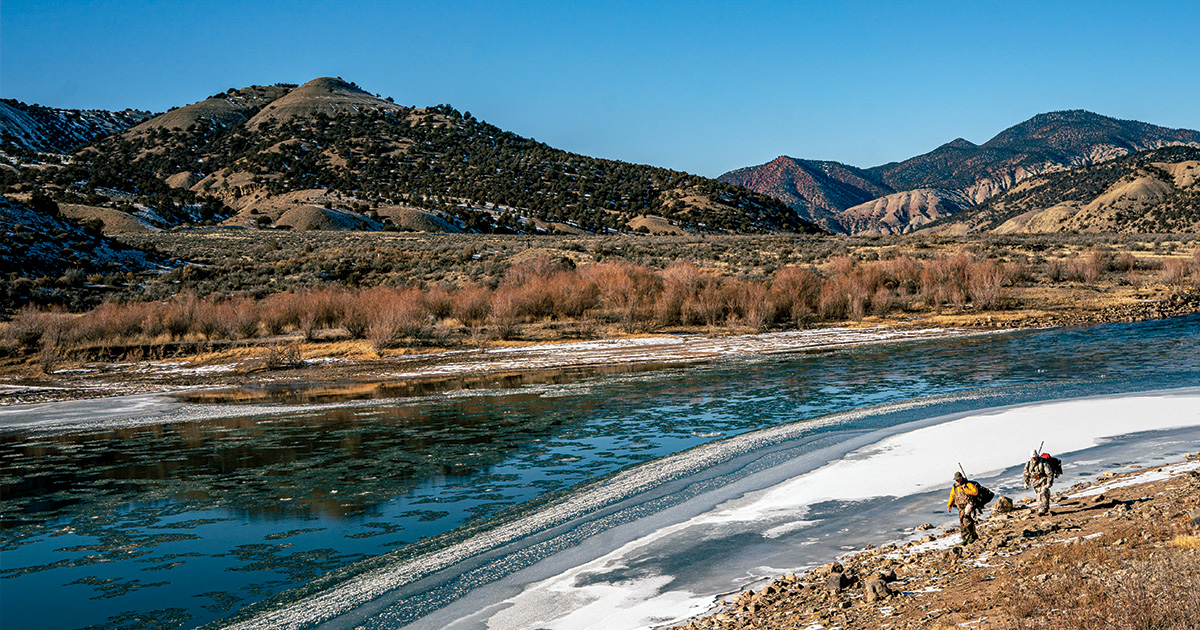
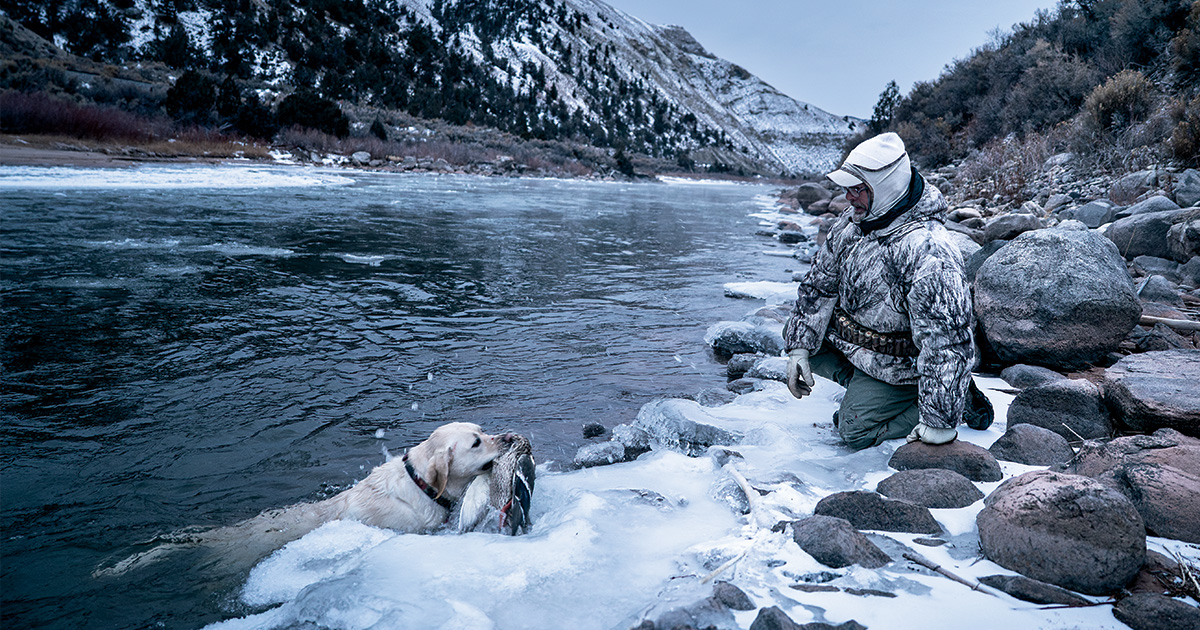
“Birds! Birds!” I shouted. Twenty feet away, Sal looked up. The ducks were coming in hot, wings folded tight against their bodies, in free fall against a winter-white sky. When they dropped below the crest of the snow-capped Rocky Mountains, I lost them for a moment in the confusing contrast of mountain and sky, then picked up the flash of set wings. I dropped a pair of mallards—one on the ice shelf along the far riverbank and the other in the narrow flume of open water that was racing down the middle of the river. Then Sal and I were on our feet and running, with Sal’s yellow Lab, Poppy, leading the way. We could deal with the greenhead on the ice later, but the duck in the river was riding a ripping current and headed for a deadly confusion of shelf ice, ice floes, slush, and deep water. And Poppy was not turning back.
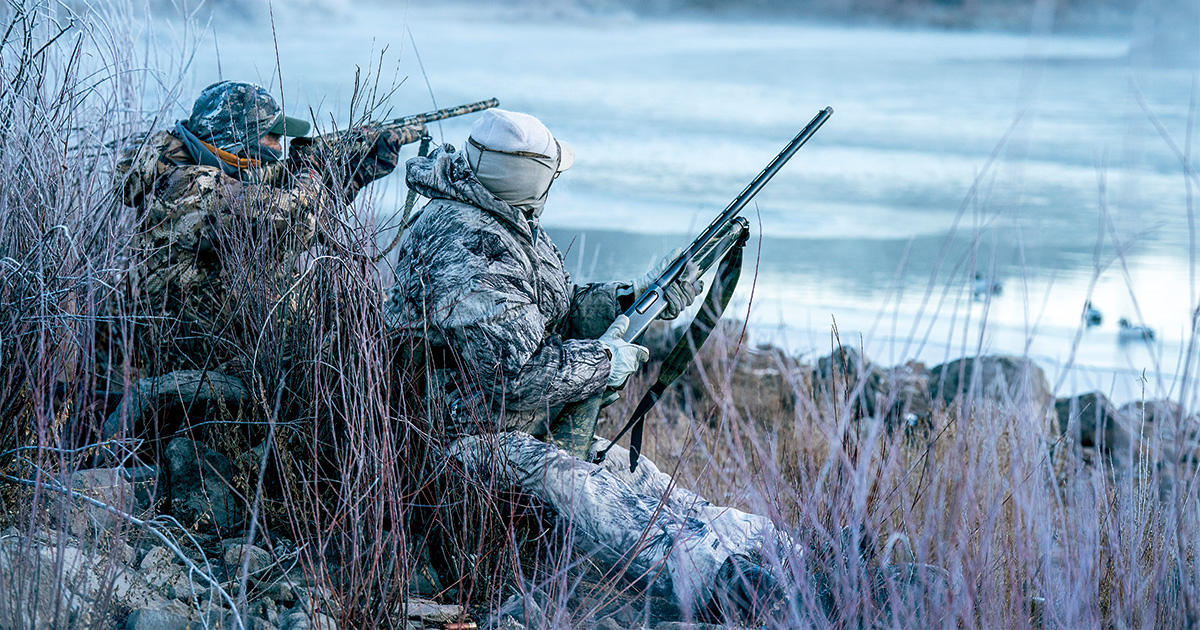
The sun rises late over the ridgeline. Time to break the ice from your decoys and move around a bit to thaw out your toes. But stay alert—these ducks come in fast. Before shooting, think about where that duck is going to land and how challenging the retrieve might be.
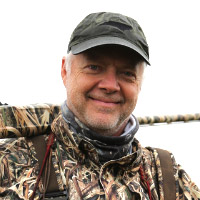
I’d been wanting to do this for a long time: hunt late-season ducks out West in extremely cold temperatures. Not the kind of cold where you can see your breath, but the kind of cold where you worry that your lungs are going to freeze if you breathe too deeply. When I told my buddy, Michael “Sal” Salomone, what I had in mind, he laughed. Sal is a recently retired high school art teacher, a part-time fishing guide, fishing columnist for the Vail Daily newspaper, and a duck hunting maniac out of Eagle, Colorado. “If you want cold, brother,” he said, “I’ll show you cold.” He warned me that it took a different kind of crazy to hunt his way.
Not to mention a dog that’s part penguin.
At the edge of the water, Poppy tested the shelf ice with a single paw, then launched into the river. Sal yelled encouragement— “Come on, Poppy! Come on, Poppy!”—as she stroked through ice, slush, and current. The duck dove but Poppy stayed focused. “Come on, Poppy!”
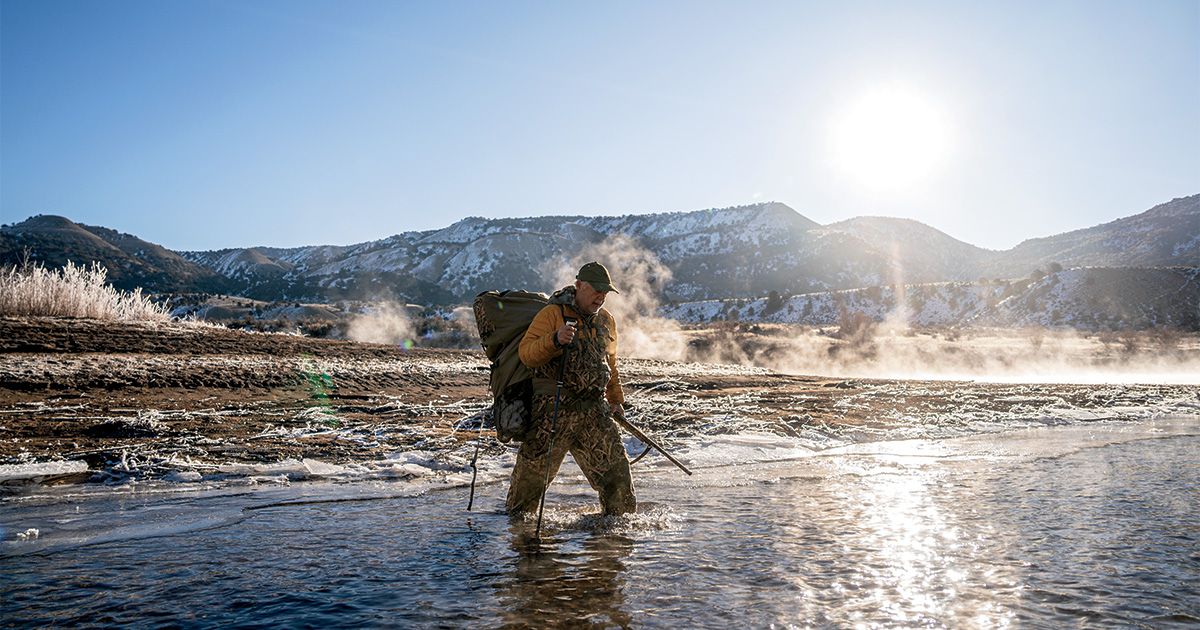
Along the riverbank, we followed the Lab downstream as she was swept with the current. When she grabbed the duck and headed back to an ice-free gravel bank, I realized that Sal had it all planned out—he knew the safest place from which to send the dog, how quickly the current was moving, and where Poppy could exit the river. An escape route, as it were.
“I always have to give her an escape route,” he would tell me later.
I suspected it earlier, but then, with a bird in hand and my breath frozen in my stubbled whiskers, it was crystal clear: When it comes to duck hunting in a world locked up in ice, this was not Sal and Poppy’s first barbecue.
Back home in North Carolina, I like to hunt places that are out of the way and overlooked, the fringe opportunities that others might pass by. In that way, Sal’s approach to duck hunting is similar to my own.
Practically no one hunts where Sal likes to hunt: the banks of the Colorado River where it pours from a deep, shadowed canyon to braid across a broad valley floor. You have to walk in, haul decoys and gear on your back, and negotiate snow, ice, very swift current, and the occasional visit by a mountain lion. In the darkness before dawn, you can see the headlights of cars carrying hordes of skiers that pilgrimage from Denver to Aspen, Breckenridge, and beyond. Twenty thousand people might drive past Sal in the morning, and I bet there aren’t three who have any idea what he’s up to.
On our first morning hunt we hiked into a place he calls the Pinch. It’s at the midpoint of a river stretch lined with springs and gravel bars. Sal has his secret names for these spots: First Spring, Rock Pile, Side Slough, Far Side. He guides fishing clients on the Colorado in the summer and understands that the same springs that keep water open in the winter hold trout in hot weather. He hunts with an angler’s brain and fishes with a hunter’s brain. It’s a formidable combination.
“After all these years, in every season,” he says, “I can throw a Hula-Hoop to where the ducks want to be. And in these conditions, if you’re not on the Hula-Hoop, then you’re not really hunting.”
And we were on the Hula-Hoop.
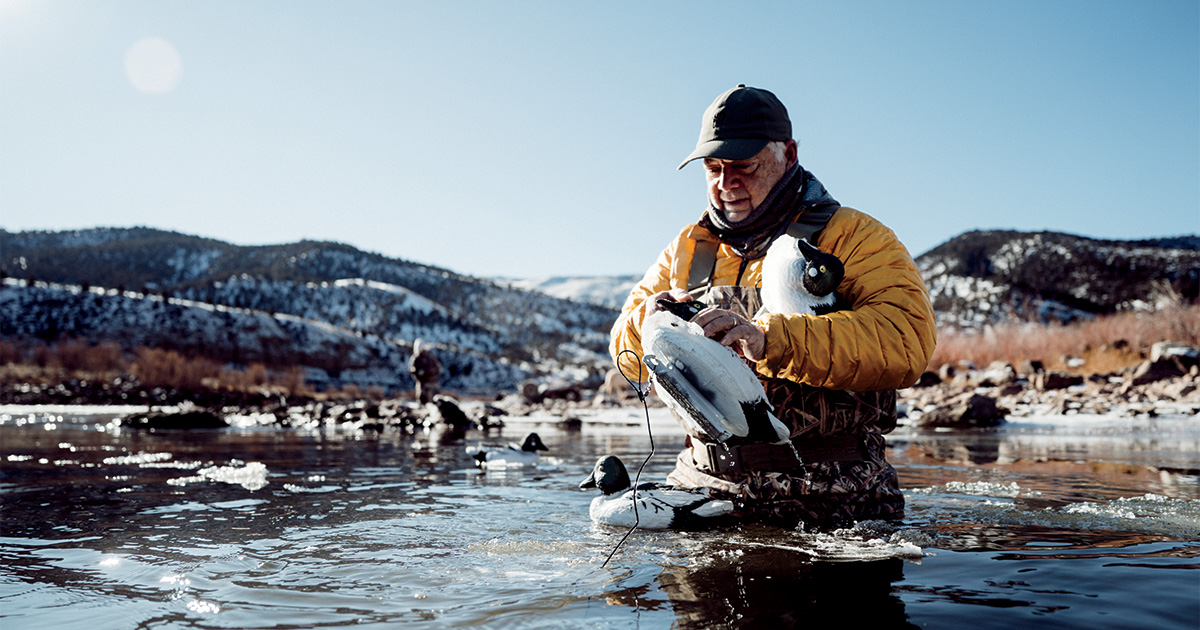
If you go, take all the layers you own. Morning air temperatures may hover around zero. Any water that’s not frozen is moving. The birds can be almost anywhere along this stretch of river. Take some time to scout in the afternoon. When you find birds, make a plan to return in the morning, toss out a dozen decoys, hunker down in the willows, and wait for the show.
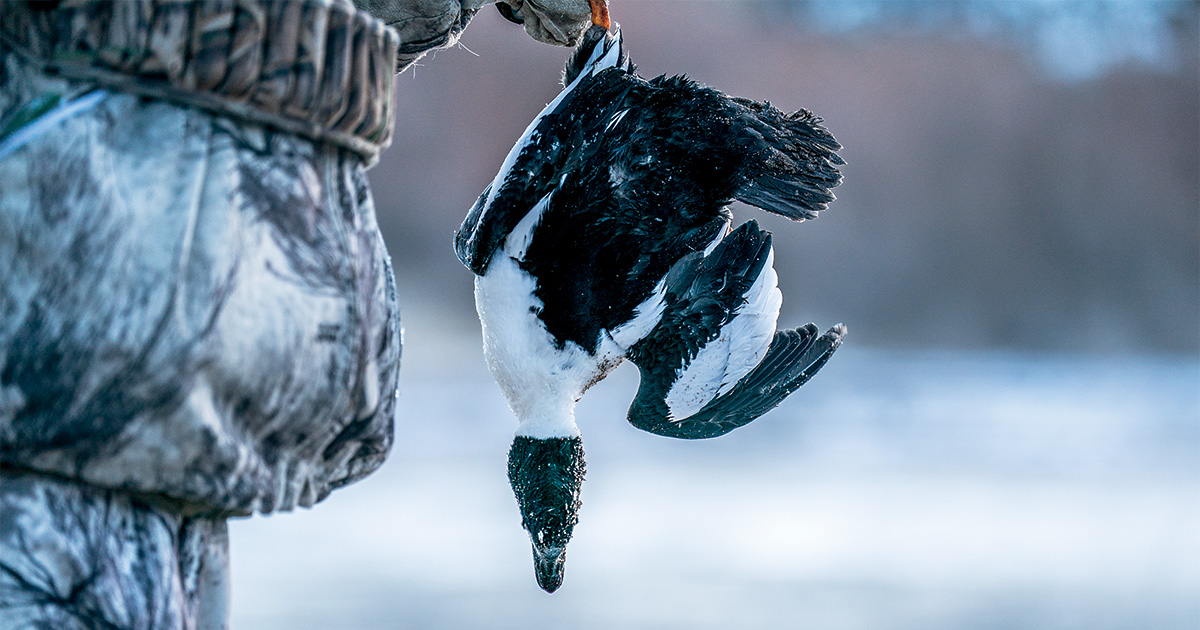
Unlike the greenheads, the goldeneyes came in low, through the billowing steam of the hot springs across the river, a low whistle from their wings announcing their arrival. Sal put the first goldeneye down hard in open water, but divers can take a licking. The bird popped up on the edge of the slush ice, then disappeared again in a hail of shot from both our guns. Then we held our fire—and our breaths—as Poppy vaulted into action.
When it’s this cold, there are approximately 436 different kinds of river ice. From the dry bank of the river a
solid ice shelf extended for a few feet and then transitioned to slush ice. Along the slush were soupy, viscous sheets of partially frozen “grease ice” and splotched chunks of “shuga ice” edged in ice crystals called “frazil.” And in the middle of all that was a tongue of ripping-fast open current that carried ice floes large enough to sink a duck or a dog, the water running swift as a puppy off its leash. No wonder Sal plots an escape route for Poppy before every retrieve.
I asked him why he hunts in these conditions. Comfort is at a minimum. Slogging through snow and ice is a grind. And he’s often targeting birds that aren’t really known for being great on the table. Earlier, Sal told me that he’s had a bunch of friends hunt with him—once. “Then they almost freeze to death,” he laughed. “So now I mostly go by myself. Aren’t too many people that can do this and think it’s fun.”
I pressed him a bit about the rewards of such an endeavor.
“What’s in it for me?” he pondered for a moment, but only for a moment.
“That dog right there,” he said, nodding toward Poppy. “You see how much she loves this. Imagine going into that water. She is wholeheartedly into it. She just eats it up. She loves it so much that I can’t help but go along for the ride.”
If mallards are honest ducks, working the decoys, drifting out of the sky on set wings, then goldeneyes are jesters. They’re big and jaunty, as black-and-white as a piano keyboard. They tend to fly low, and in small groups, and maybe they’ll swing into the decoys or maybe they’ll just zip past without even nodding a courteous hello.
We were happy to wait them out. I was surprisingly comfortable, given that I’d settled into island willows sheathed in white hoarfrost, with my back pressed against a mud bank frozen solid as, well, ice. I was dressed in nearly every article of clothing I had packed. I’d even conscripted my pajamas to serve as backup insulation. Just upstream of our island, a quarter-mile-long ice bridge had formed across the river, and on the far side, steam plumes from hot springs marked more enticing open water. But there were places on the Colorado River—favorite places but treacherous places—where Sal has promised his wife, Lori, he will never hunt again. We hunkered down and listened to whistling wings overhead.
In the early light, before the sun rose above the tall mountains, the goldeneyes came in like bats, low to the water and through the fog, so fast in the darkness that we could hardly react. Once the sunlight crested the ridges, however, the white-backed birds showed up clear as meteors in the sky, like snowballs hurled up the river.
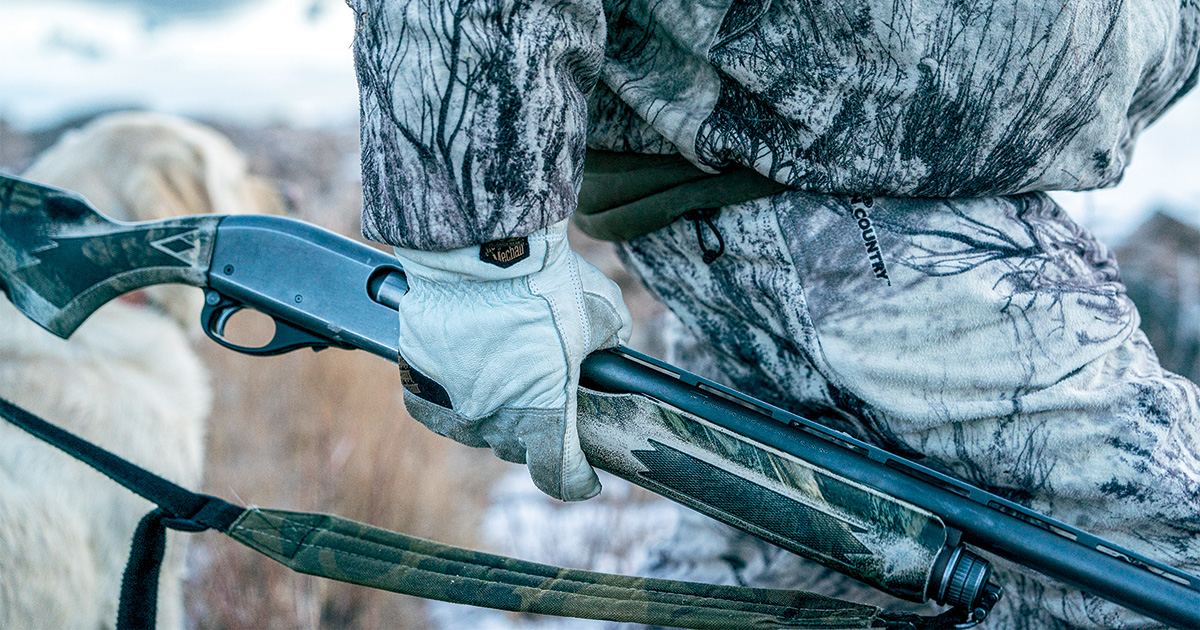
But every shot required a certain kind of mental gymnastics. This wasn’t like knocking a greenhead down in the timber. Pulling the trigger was just the beginning. We had to shoot birds that would fall where Poppy could get to them with little risk. It was all a part of the game of a hunt like this, working out the calculus of the ice, the cold, the shot choice, the dog, and the birds that came so fast you had to do the math in a matter of seconds.
It was during a break in the action when I saw something so surreal that I figured the chill in my spine had infiltrated that part of my brain that governs common sense. Out of the corner of my eye, I saw a small bird standing on an icy rock. It bobbed up and down, then swan dived into the open water and disappeared.
“What is that?” I asked Sal.
“A water ouzel,” he replied.
I furrowed my brow. “A wooty which?”
He laughed. “A water ouzel. Believe it or not, they dive to the
river bottom for nymphs. Like a trout. Cool, huh?”
It was hard to fathom, but there it was. The little songbird was the size of a robin and the color of ash, but with the gumption of a seal. It stood on a rock, analyzing the slush ice rushing past, then suddenly nose-dived into the water, disappearing like a loon. It popped up a few seconds later and a few feet downstream, launched itself from the grip of the current, and landed back on the rock, none the worse for wear. Barely a handful of sooty feathers, rooting around on the river bottom for bugs.
Those birds are crazy, I thought to myself, pondering what a tough life that must be, skin-diving for rock bugs in 40-degree water. Then I looked around. The air temperature was in the single digits. Every time I moved, tiny glaciers of ice crinkled and calved from my waders. The cuffs of my pajamas poked out from the sleeves of my parka. They were frozen, too. I guess the water ouzels were no crazier than we were.
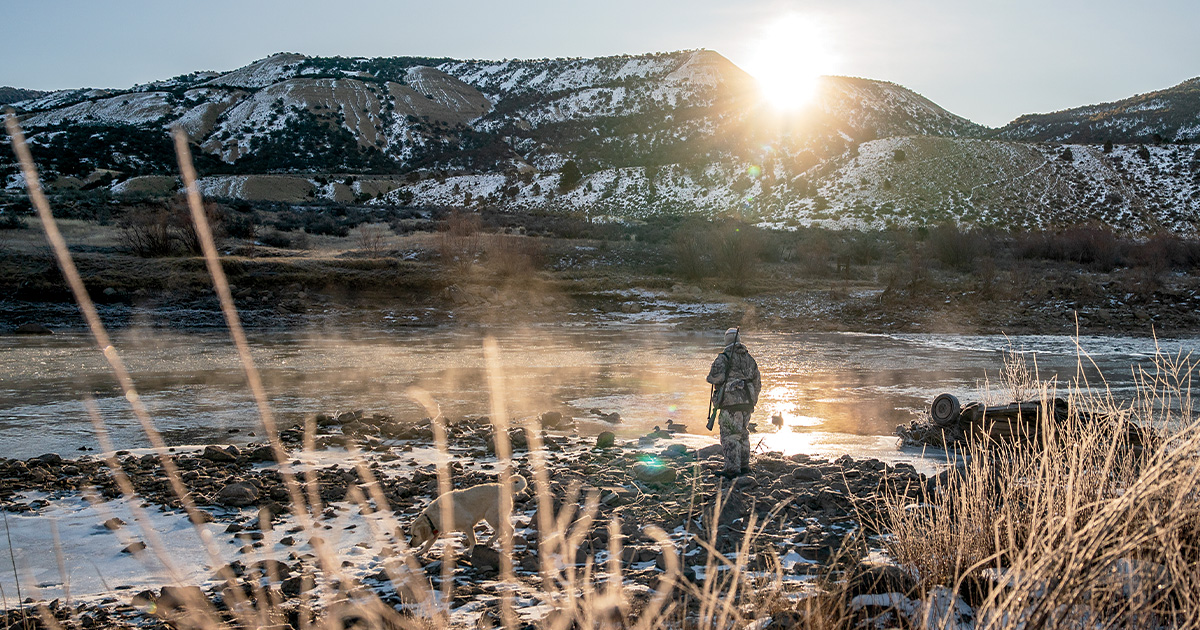
The sun rises late over the ridgeline. Time to break the ice from your decoys and move around a bit to thaw out your toes. But stay alert—these ducks come in fast. Before shooting, think about where that duck is going to land and how challenging the retrieve might be.
After all that quality time in the waterfowler’s version of Narnia, we were ready for a break from the arctic. In the afternoon, we were driving up the Colorado to a public walk-in area and scouting for birds hidden by the tree-covered bluff. By chance I spotted a golden eagle swooping low over the water. Suddenly, the raptor pushed a half-dozen mallards into the air.
“Stop! Stop!” I hollered, and Sal hit the brakes. We eased the truck to the guardrail and peered over the side of the road. Through the trees we spotted another two dozen mallards dabbling against the bank.
“There’s your Hula-Hoop,” I said. “Scouting is hunting.”
“Oh, yeah,” Sal smiled. “Poppy is going to be a very happy girl.”
The next morning, we walked about 50 feet from the road’s guardrail, slid on our butts down a steep riverbank, and popped out on a shrubby gravel bar where all we had to do to disappear was sit down. Putting a dozen decoys out took all of seven minutes. To be honest, I never wanted it to be so easy. There were no guarantees the ducks would return, of course. The eagle could have spooked them to the next county. They could have bolted to New Mexico. But with the sky lightening in the east, we had the feeling that on this morning, at least, we’d cracked the code.
They gave us a scare. The mallards didn’t show until 20 minutes after shooting light, after we’d downed a couple of goldeneyes and were beginning to think we’d have to be happy with that. But when they came, they came like honest ducks: black pepper in the far-off sky, birds that barreled in from a thousand yards away, knowing the precise square foot of water they planned on landing in.
I lay down on a wrack line of flood debris and watched them come. I love birds that work the decoys, that circle the rig and talk back at you and make you sweat before they commit. But there’s nothing wrong with birds that know where they want to be and take a straight line to get there. These greenheads set their wings when they were a quarter-mile from the water—and didn’t waver. “Coming in hot,” I hissed to Sal, but he hardly needed the heads-up. I could see Poppy through the reeds, eyes on the sky, shivering with excitement.
Her time was coming.
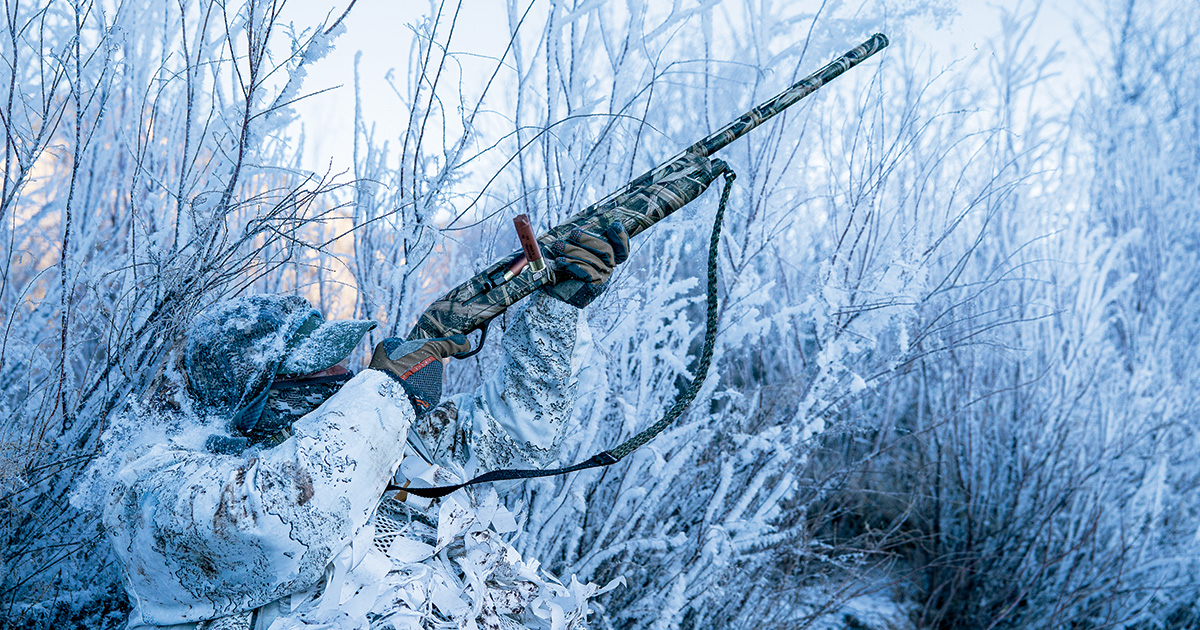
We had to make a bold move on our last morning. We’d been pushed around the river, bullied by ice conditions that changed by the day and by the hour. When we parked the truck by the river, the thermometer read -1 Fahrenheit. Ice cover on the river had been moving steadily upstream for days, and now our best shot would be along a gravel bar a few hundred yards from our earlier hide. A nearby spring would keep a lane of water open, but it was a long haul and required two river crossings where the Colorado braided between frost-sheathed islands. We broke through ice, heavy decoy packs groaning on our shoulders, and leaned on stout staffs as we picked our way across the braids.
“Is this Lori-approved?” I asked Sal, remembering his husbandly oath to be a good boy.
“What? Huh?” He splashed the water with his wader boots.
“Can’t hear you.”
I’ve always struggled with a duck trip’s last-morning hunts. I have a hard time keeping my head in the game. I tend to get preoccupied with packing up, getting to an airport, and fretting about the logistics. After we set the decoys and hunkered down at the head of the island, my mind was soon wandering.
It didn’t help that half our decoys froze in the ice. Or that the ducks didn’t show.
But we never thought we’d be hunting giant flocks of birds. Not on a Rocky Mountain river in the deep clutches of winter. Most ducks had vamoosed to warmer climes and easier living. We were hunting the hard cases, the stick-arounds, the knuckleheads that didn’t know any better. Which sounded a little like us.
And I was good with that. It had been a classic bootstraps trip—working the angles, scheming, plotting, adapting. There were long lulls of nothing and frantic moments of chaos. Laughter and sweat and second-guessing and actually getting a few things right.
We sat with our backs against the frozen mud bank, hidden by great plumes of frost-clad willows. Water ouzels worked the swift water, and sunlight crept down the flanks of the mountains. From the start, it was going to be a short last-morning hunt, and the morning soon had that feeling that the window had closed, that there was now too much ice and not enough open water, and that these birds had probably had enough of us.
But I knew two things beyond the shadow of a frozen doubt: Ducks could appear at any moment, or ducks could never appear at all. Either way, I found myself grinning. Steam billowed from the springs across the river like the breath of giant bison, and the ice shelves groaned, and slush ice raked through the decoys in the river with a sibilant hiss. I couldn’t help but think that we weren’t the crazy ones, after all. Who in their right mind wouldn’t want to do this?

Share this photo


Ducks Unlimited uses cookies to enhance your browsing experience, optimize site functionality, analyze traffic, and deliver personalized advertising through third parties. By continuing to use this site, you agree to our use of cookies. View Privacy Policy