"The Canada Goose: Etched in Time, Carved in Wood" is a beautiful new book that celebrates the fascinating natural history of these iconic birds. In these excerpts, we follow the travels of a fictional goose and meet some of the people whose stories helped shape the unique culture of goose hunting and decoy carving in North America.
Published on November 10, 2025 •
13 min read
By Mark Petrie, PhD
Illustration by Gordon Allen
Native North Americans have lived alongside Canada geese for thousands of years, but the first European to see a Canada goose was almost certainly a Viking. By the end of the 10th century, the North Atlantic Ocean had become a Viking bathtub. Scandinavia had proved too small for the Norsemen, and they began raiding monasteries along Britain’s northern coast in 793. It was the first step in an island-hopping campaign that brought the Vikings to Greenland in 985, and by 1000 they were restless to move again. The Viking who would lead them farther west than any other was Leif Erikson.
Erikson was chasing a rumor. In 986, a Viking merchant ship had become lost south of Greenland. The crew eventually sighted a land covered in forests, but the men knew it could not be Greenland. What they had seen was North America, and they were the first Europeans to do so. The ship’s captain, Bjarni Herjólfsson, decided not to drop anchor. Instead, he regained his bearings and found Greenland a few weeks later. Determined to finish the journey, Erikson purchased Herjólfsson’s boat in 1000. Known as a knarr, the ship could carry between 20 and 30 tons of cargo. Erikson’s cargo was men of adventure, and in early June he loaded 35 Vikings into the knarr and set sail for the next world.
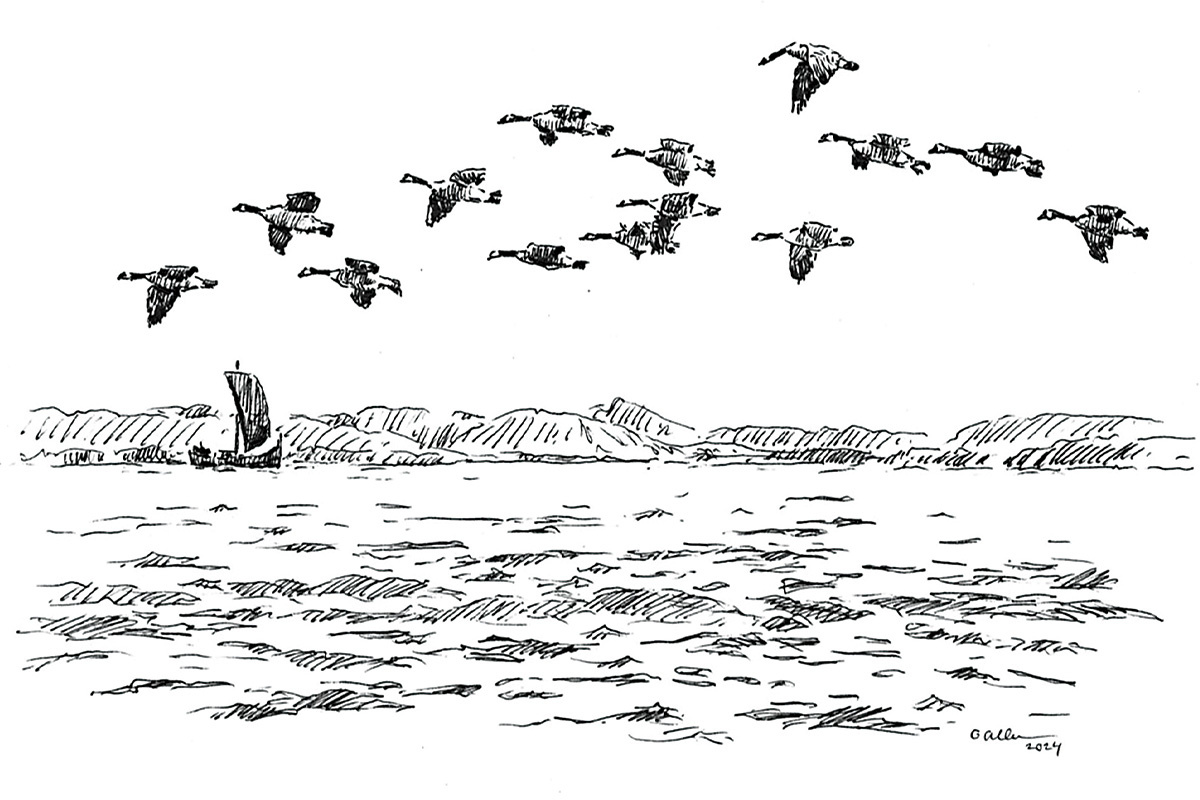
They struck North America somewhere on the coast of Baffin Island and named it Helluland, or “land of flat stones.” Several more days of sailing put them off Labrador’s southern coast, where trees covered the land, so they named it Markland, or “forestland,” and eased the knarr ashore. Erikson and his crew had landed in the home of what biologists now call the North Atlantic Population of Canada geese.
Illustration by Gordon Allen
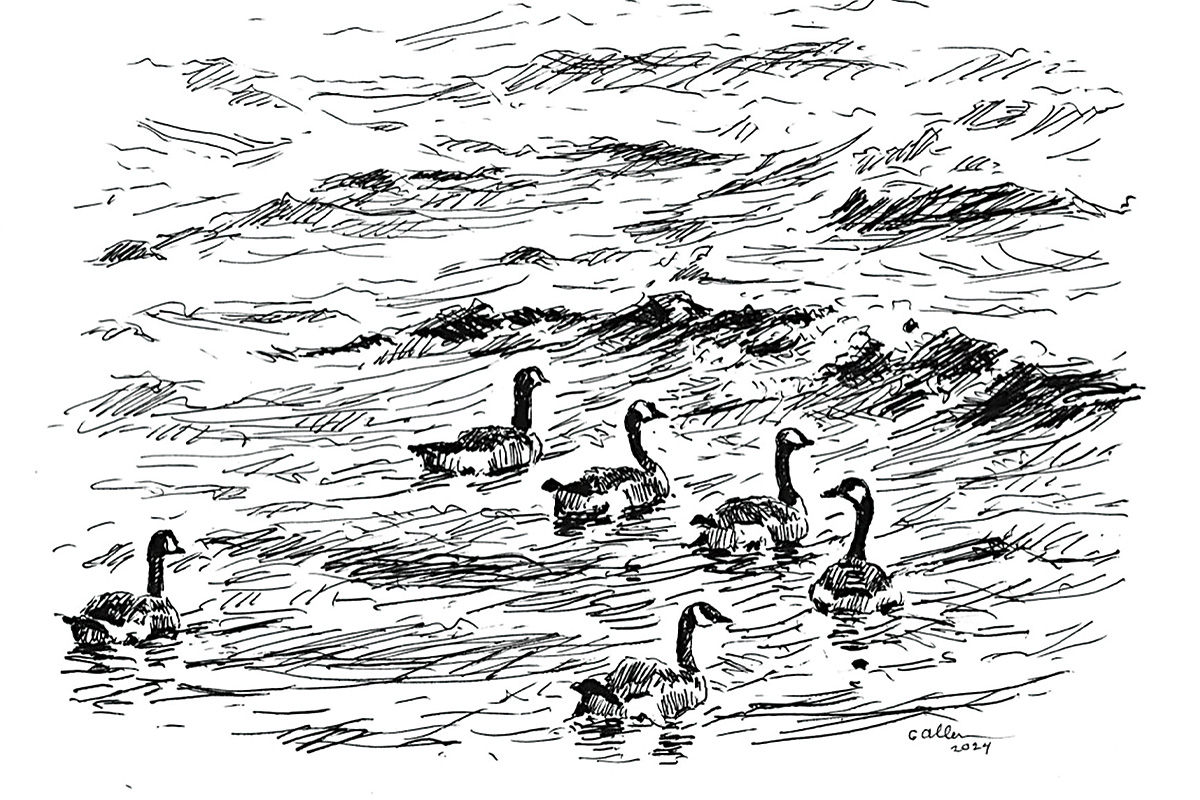
On the morning of May 25, 1906, a lone pair of Canada geese slept just south of an old Viking settlement in Newfoundland. The female awoke and, impatient to be on her way, nudged the gander. They had left New Jersey in early March after spending most of the winter there. Tethered to the growing daylight, their journey north up the Atlantic Seaboard had been at a leisurely pace, but today she would hurry on a south wind that was already building. By noon, they were off the Labrador coast near Cape Charles. From there, they continued north, staying just offshore, and with the sun setting, they turned inland and found the nameless lake that marked the end of their journey. On the lake was a small island of granite.
The pair had much to do during the short Labrador summer. Eggs would be laid and incubated. Young must be raised and fledged before fall, and adults had to replace their flight feathers. Although all these tasks were important, their order was governed by an iron law—goslings needed to hatch when food was abundant. Otherwise, their chance of survival was slim. Meeting this timetable meant laying eggs at just the right time.
The goose laid her first egg on May 29 and her sixth and final egg on June 6, averaging an egg every day and a half. She had lined her nest with down plucked from her breast, and the bare skin helped pass heat to her eggs as she incubated them. A dedicated mother, she left her nest only twice a day for 15 or 20 minutes to drink, preen, and nibble at green vegetation now beginning to emerge. During these short recesses, the gander kept a watchful eye on both her and the island. On the morning of July 3, 28 days after she had begun incubating, she heard a steady tapping noise beneath her. Soon the tapping grew louder as more goslings began hammering away at their calcium prisons. Their work continued day and night. The goose sat tight, skipping her usual recesses, and the gander remained in front of the island, never moving.
The first gosling hatched around midnight on July 4 after cutting a neat line near the large end of its egg and opening a door to the world. Last to hatch just as the Labrador sun rose was the gosling we will call the Viking gander as we follow his life’s journey. For some time, he lay there exhausted by his efforts. Eventually, the gosling gathered his strength, and his down began to dry. Staring at him were five siblings impatient to be on their way. There was much to see.
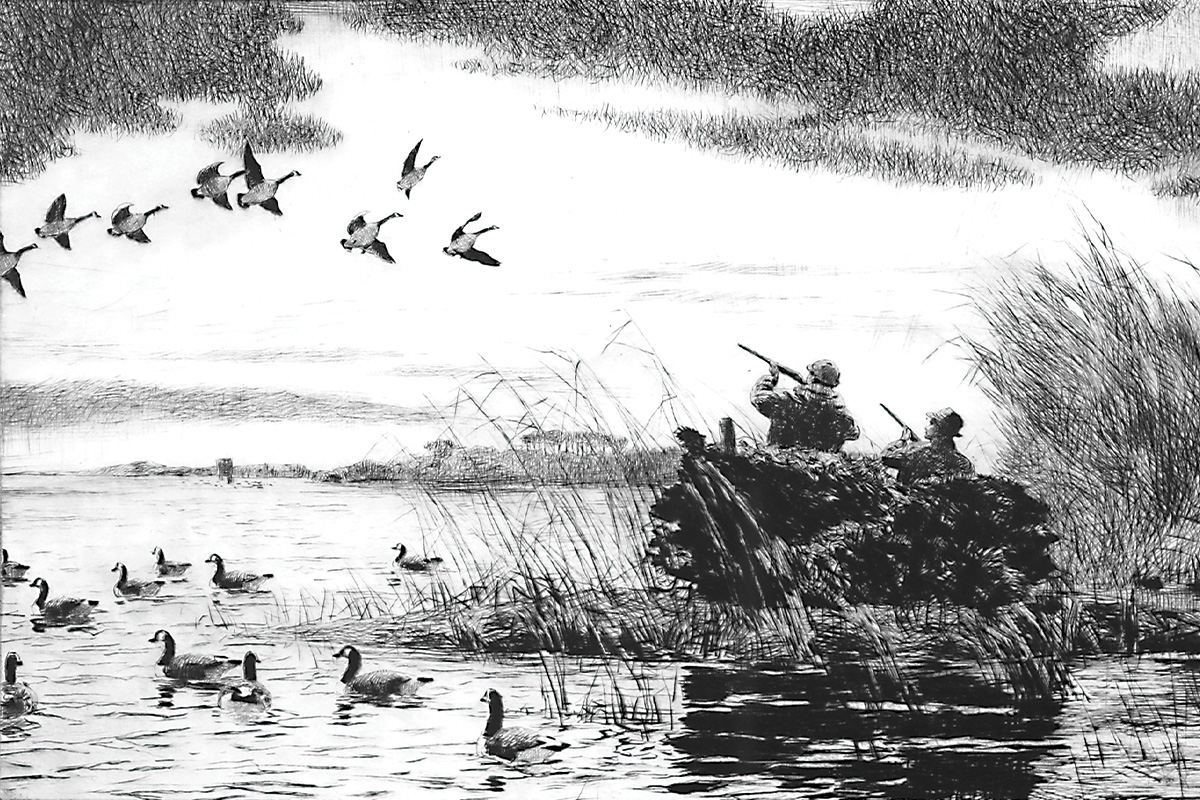
Allen Lassell Ripley, Goose Shooting
In 1918, the Migratory Bird Treaty Act (MBTA) implemented the Migratory Bird Treaty that the United States and Great Britain (on behalf of Canada) had signed in 1916. On the day the act was signed, the Viking gander and his mate were in western Labrador raising a new generation of goslings. The MBTA would impact his life and his descendants’ lives in two ways. First, it eliminated spring hunting by making it illegal to harvest waterfowl after January 31. It also made it a crime to sell birds, ending market hunting, or at least driving it underground. Live decoys would not be outlawed until 1935, but the MBTA effectively ended the era of unregulated waterfowl harvest in North America.
The Viking gander’s journey up the Atlantic coast in the spring of 1919 was unique because now the blinds lay empty, and no decoys bobbed in the surf. As most hunters know, waterfowl change their behavior within days of the season being closed as they swap caution for trust. By mid-February, the geese in New Jersey’s Barnegat Bay were feeding wherever they pleased while the hunters’ sneakboxes rocked in their moorings or rested on shore. Only the tide dictated when and where the geese fed, and the birds grew fat in the newfound safety of spring. Still, the Viking gander remained vigilant. Not once on the long journey back to Labrador did he fail to circle high before landing. Some men had defied the law that spring, and his stubborn caution was rewarded more than once.
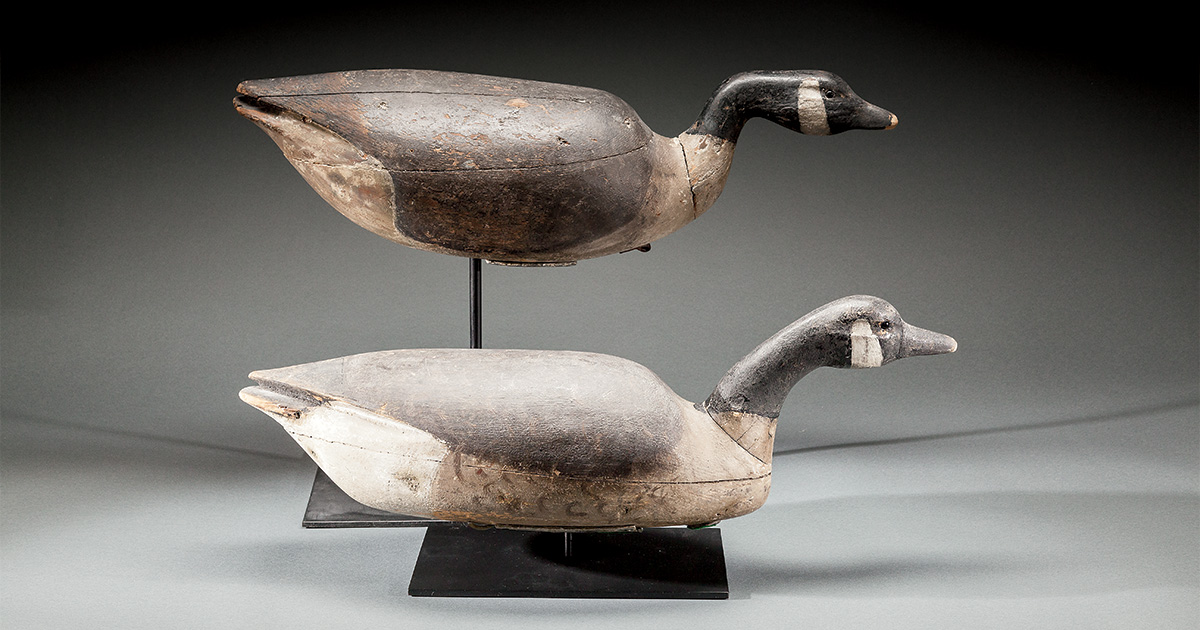
Nathan Cobb Jr., Cobb Island, VA, c. 1880
As this pair of Canada goose decoys from the Peterson collection illustrates, Nathan Cobb Jr. understood the value of implying action and movement within a decoy rig. He added hissers, swimmers, and feeders to the rig by making necks from scavenged Yaupon holly and wax myrtle limbs. This pair is among the finest Cobb goose decoys known to exist.
By 1919, the Viking gander and his mate had been paired for a decade, and both were in their 13th year. Few Canada geese live beyond a decade, and their partnership had been unusually productive. Together they had fledged more than 40 goslings, nearly twice as many as their cohorts had. Most of their winters had been spent in New Jersey, but in colder years they had explored farther south. One winter they reached Ocracoke, North Carolina, not far from the southern end of eelgrass range. In the spring of 1919, they journeyed to western Labrador and the little lake where so much of their lives had been spent.
The goose managed only five eggs that spring, as age was beginning to stalk her. Still, they were able to fledge four goslings, and October found them once again preparing to leave for Tabusintac Lagoon in northeastern New Brunswick. That morning, the six geese were feeding at the southern end of yet another nameless lake when they were joined by a family group of five. The Viking gander swam toward the uninvited guests with the youngsters in tow, but the goose did not follow.
For some time now, the lynx had been watching her. He had killed geese at this lake before, but never at the water’s edge. That lesson had been learned, and now he waited for the birds to come ashore and to him. Growing near the lake’s margin was a large patch of crowberries. Few foods in Labrador are so easily turned into fat as the sugar-rich crowberry, and fat is what fuels migration. Why geese ate crowberries was of no concern to the lynx. He had simply learned that they often wandered on shore in search of the berries, and that is where he set up camp.
Bob Piscatori, Massachusetts Goose Decoys
Canada geese were comfortable on land long before the modern combine lured them into the fields, and there has always been a terrestrial ingredient to their nature. That summer, the Viking gander’s aging mate had failed to recover her weight, and she had been spending more and more time searching for crowberries to make up the deficit. She remembered that the berries grew near this end of the lake, so she walked inland and toward the hidden cat. Her struggle was brief and nearly soundless, and the Viking gander did not notice her absence for some time.
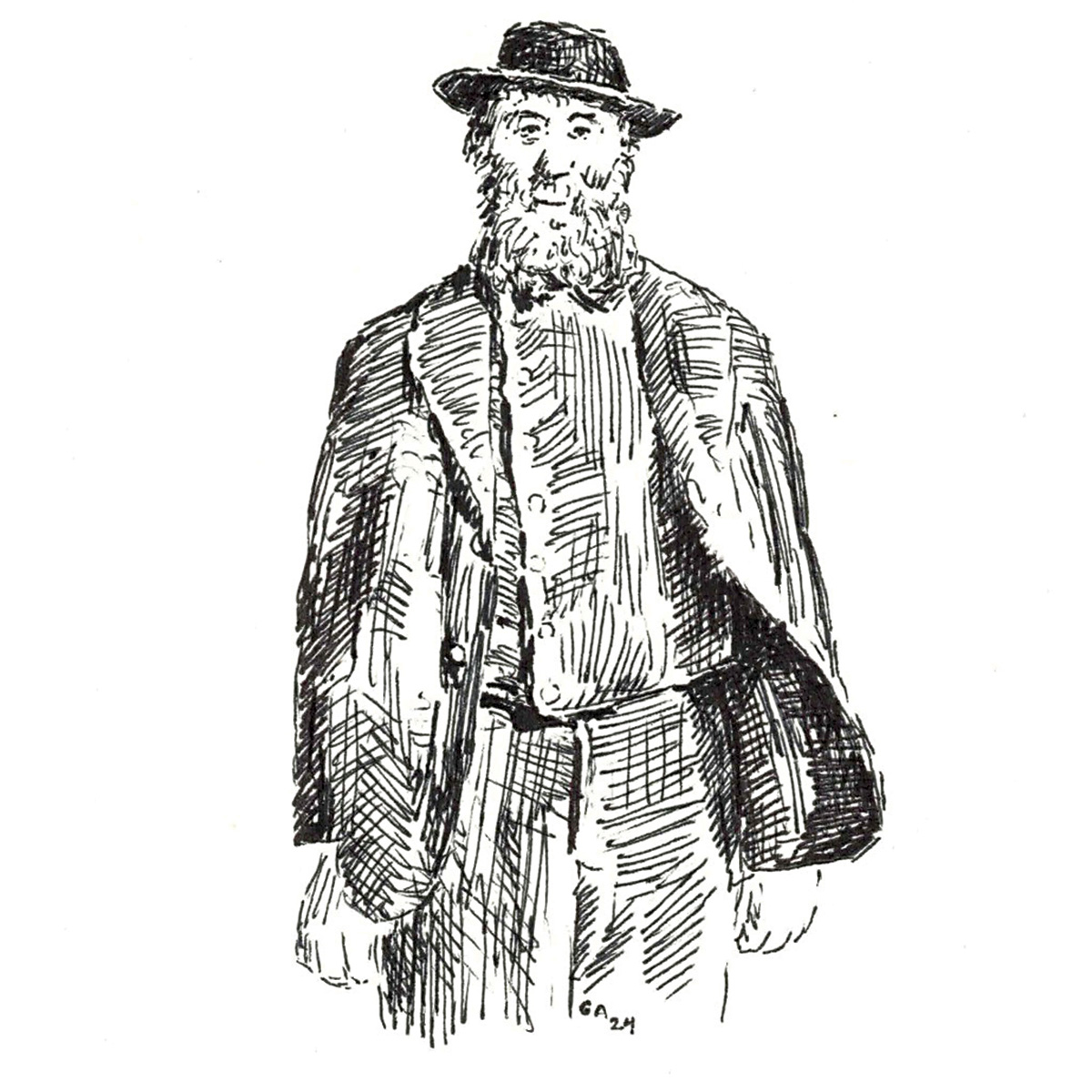
He was the last of the Cobb Island Cobbs. George Cobb had been born on Cobb Island in 1869, and by 1931 he was the island’s last permanent resident.Cobb Island, one of the barrier islands along Virginia’s Eastern Shore, is separated from the mainland by an area once locally known as the Broadwater. George’s grandfather, Nathan Cobb, had purchased the island in 1839 after leaving Cape Cod, where he had been a sea captain and shipbuilder. After his wife contracted tuberculosis, he had left the cape, hoping that Virginia’s climate would help her recover. Sadly, it did not, and in 1840 she was buried on the Virginia mainland.
Cobb Island was originally known as Great Sand Shoal. Mostly sand and marsh, the island was nearly seven miles long and averaged about 400 yards wide. Nathan first used the island as a base for salvaging ships, but he quickly recognized the waterfowl hunting and fishing opportunities the area offered. By the 1850s, he and his three sons were hosting sportsmen on the island. One of those sons was Nathan Jr.
Nathan Jr. had the talent to see the birds as they were, and he merged that skill with one of the most unique ingredients ever used to fashion a goose decoy. Cobb Island was home to large numbers of Yaupon holly and wax myrtle. The limbs of these evergreen shrubs were scattered across the sand, and some of them closely resembled the many head positions of a Canada goose. The resemblance was so close, in fact, that often very little carving was needed. Nathan Jr. could simply take a walk and pick them up. His genius was in seeing what those dead limbs might become.
Illustration by Gordon Allen
George Cobb had been among the first to realize that eelgrass was dying. By now, most of his clients were fishermen who came to the island to catch black drum and redfish. That summer, he had noticed the eelgrass leaves turning black, and soon nearly all of it was dead. He was concerned for the fishery and his livelihood, but he also feared for the brant and Canada geese that made their home there.
That winter, the Viking gander migrated down the coast with his family, as he had done for the past 25 years. On January 11, 1932, he reached Virginia’s Eastern Shore just a mile off Cobb Island’s north shore.
George Cobb decided to go goose hunting the next morning. Choosing where to hunt should have involved the usual calculus of tide, wind, and experience, but the normal patterns of bird life had disappeared with the eelgrass. The brant seemed especially frantic, and each day their numbers dwindled. How different it was from the days when his family’s island hotel was crammed with goose and duck hunters,
and he had helped load the skiffs with Nathan Jr.’s decoys. His uncle had been dead for 25 years, but enough of his decoys remained to hunt over, which was a testament to their superb construction. He settled on Big Easter Island, his decision based more on nostalgia than anything else. The island was about two miles west of Cobb Island toward the Virginia mainland. It had been a popular spot back in Nathan Jr.’s day, and George gave no thought to crossing the open water alone and in the dark.
That night, the Viking gander and his family roosted off Cobb Island with a dozen other Canada geese. Their morning flight took them in the direction of Big Easter and into the wind. The day was mostly clear but with a good breeze, and they passed over several flocks of brant bobbing in the surf. Up ahead was Big Easter, and already the Viking gander could see the white rumps of his fellow geese as the January sun struck the water.
In the heyday of the late 1800s, the Cobbs often guided 15 to 20 hunting parties a day. Scattering them throughout their hunting grounds ensured better shooting for everyone, and clients were taken afield in steam or sail-powered sloops. Skiffs would be towed behind the sloops to shuttle hunters to and from their blinds. That morning, George had no need for such logistics. He simply loaded up a skiff with decoys and rowed in the direction of Big Easter. He reached the island at first light, pulling the skiff into a boat blind he had rebuilt that fall.
Illustration by Gordon Allen
Although Cobb had hunted over his uncle’s decoys for nearly 50 years, he never failed to marvel at the scene they created. Most hunters prefer decoys made in a variety of poses, and Nathan Jr.’s birds certainly offered that. But these decoys had something else, and it had taken George more than a few mornings to put his finger on it. When placed together, Cobb’s decoys were more than the sum of their parts; they were a new math altogether. Their unique poses gave each bird its own personality, but Cobb had improved on that technique by knitting those personalities together so that his decoys seemed to be responding to one another. Within his community of imposters, you might see a goose with its neck outstretched, seemingly hissing at a neighbor for some imagined insult, or two birds appearing to swim determinedly for the same bit of food.
The Viking gander stuck to his routine even as Cobb’s splendid decoys came into view. As always, the first pass was high and well out of gun range. But the decoys had earned a second look, and the Viking gander brought the geese around again, lower this time, but at a height where bird shot lost its battle with gravity. As a rule, he never landed among birds that lay close to shore even when he was certain they were live geese. Aside from a sinkbox, a shoreline is where most of the danger waited. Better to land downwind of the flock and inspect his new friends from a distance.
Cobb was not optimistic. A high pass often exposed the chinks in a hunter’s armor, and the big gentleman out front clearly knew what he was doing. Their second pass restored some of Cobb’s confidence, but the game he and the birds were playing was still in the middle innings. If that second pass gave the decoys or his blind a failing grade, it would end right there. But Cobb was hunting alone, and his ability to keep still and resist looking up gave him an edge. Still, he was surprised when the geese turned a third time and set their wings. Watching them, he felt the old excitement rise in his chest as the birds became impossibly big.
Who can say why the Viking gander chose to land among the decoys, and what hunter among us can always predict what the birds will do? Cobb’s decoys may have been the best he had ever seen, and there was no shame in being fooled by them. Still, he had abandoned his own rule about not landing next to shore. Maybe it was hunger, or weariness, or both.
Cobb did not shoot even as the geese discovered their mistake and frantically regained flight, but he would have struggled to say why he left the old 8-gauge Sneider in his lap. Perhaps he felt that the birds had been troubled enough by the eelgrass dying, and this was his offer of help. George Cobb did not live to see the eelgrass recover. In August of 1933, he drowned in a hurricane that roared across the Eastern Shore and brought his family’s dynasty to an end.
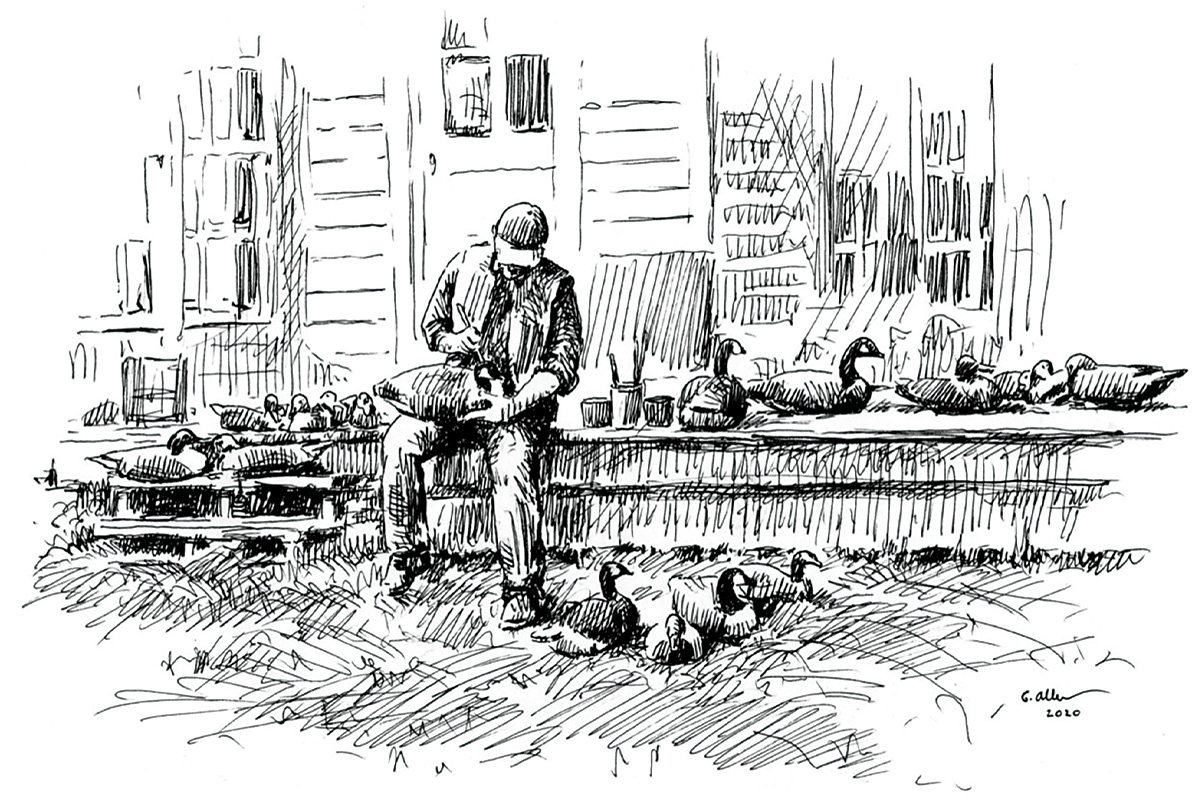
Carver Profile: Nathan Cobb Jr. (1825–1905)
Illustration by Gordon Allen
Nathan Cobb Jr.’s hollow-bodied decoys were of rugged construction consistent with the severe weather conditions that often plagued the island off Virginia’s Eastern Shore, where his family operated a large hotel and guiding business. He produced ducks, geese, and shorebirds in a multitude of poses, which helped add a sense of movement and realism to the rig. Curved and twisted necks with canted heads, notched tails, and inlet heads are characteristics that set Nathan Jr.’s decoys apart from other Virginia makers.
Peterson Decoy Collection on Display
Elmer Crowell, East Harwich, MA, c. 1915
A new exhibit at the Ducks Unlimited Waterfowling Heritage Center inside the Bass Pro Shops Pyramid in Memphis, Tennessee, features Canada goose decoys from the renowned Peterson Collection. The exhibit invites visitors to explore the enduring legacy of the continent’s wild geese and the deep cultural ties between hunters, geese, and conservation.
Derek Christians
The exhibit’s richly detailed and beautifully illustrated companion book, The Canada Goose: Etched in Time, Carved in Wood, by Dr. Mark Petrie, is available at the exhibit or at ducks.org/canadagoose.
Select Location
State Abbreviation or Zip
Share this photo
We Use Cookies
Ducks Unlimited uses cookies to enhance your browsing experience,
optimize site functionality, analyze traffic, and deliver personalized
advertising through third parties.
By continuing to use this site, you agree to our use of cookies.
View Privacy Policy