Cupped Wings: That Sinking Feeling
Hunting ducks from a North Carolina curtain blind transports the author back to waterfowling’s storied past
Hunting ducks from a North Carolina curtain blind transports the author back to waterfowling’s storied past




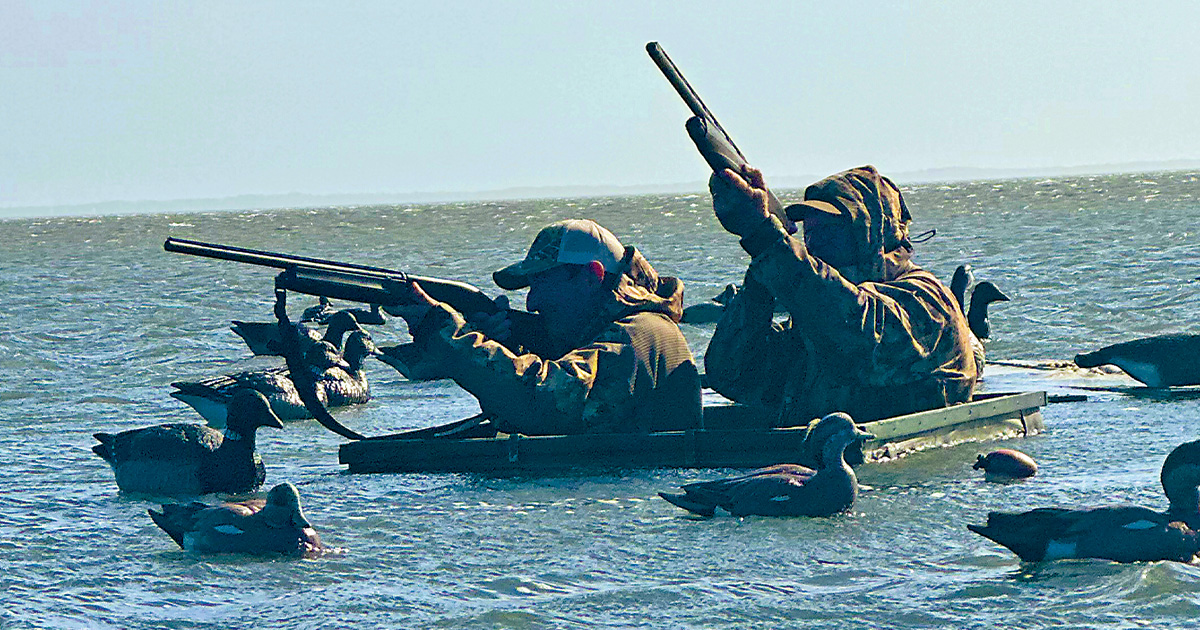
Back in the day, this is what they saw: The ducks coming in at eye level. The decoys dancing in the chop. The breaking foam of heavy water across Hatteras Reef, a massive shoal four miles into Pamlico Sound from the bend of Cape Hatteras. Rubbing shoulders with me in a North Carolina Outer Banks curtain blind, my pal Don Lee gripped his 12-gauge and muttered, “This is something else.” I couldn’t tell if he was talking about the pintails on a beeline for the decoys or the vast sweep of Pamlico Sound-a water body so large that the early European explorers thought it was the Pacific Ocean-or the fact that we were basically invisible to the ducks because we were basically underwater.
Probably all of the above.
In Dare and Hyde Counties of eastern North Carolina, a handful of guides and locals carry on a tradition with roots in the storied culture of market hunting: hunting out of curtain blinds, the closest you can get to the sink boxes of yore. What makes them legal is that, in contrast to a true sink box or battery, a curtain blind doesn’t float. Instead, it is anchored to the sea bottom. It’s essentially a pit blind in the middle of the water, a metal box sunk some three and a half feet into sand and muck using generator-powered jet pumps. It’s an intricate affair requiring heavy weights to anchor the contraption and a half day of manpower to set it into place. The entire apparatus is wrapped in heavy waterproof cloth—the curtain—that can be raised and lowered as the tides rise and fall and the wind whips the sound into a froth. The blind is large enough for approximately one and one-third human beings, which makes it tight as a tick for the two hunters that usually crawl in. Tight as a tick and a little wet and a whole lot clammy, but also unforgettable.
Our guides are Captains Rom Whitaker and his son, Rom Whitaker Jr. The Whitaker family is one of the most respected names in saltwater fishing along the Outer Banks, and they are among the last remaining practitioners of Outer Banks curtain blind gunning. They’re keeping an eye on Don and me from a blind and tender boat a few hundred yards away, ready to lend a hand if we put birds down that we can’t retrieve.
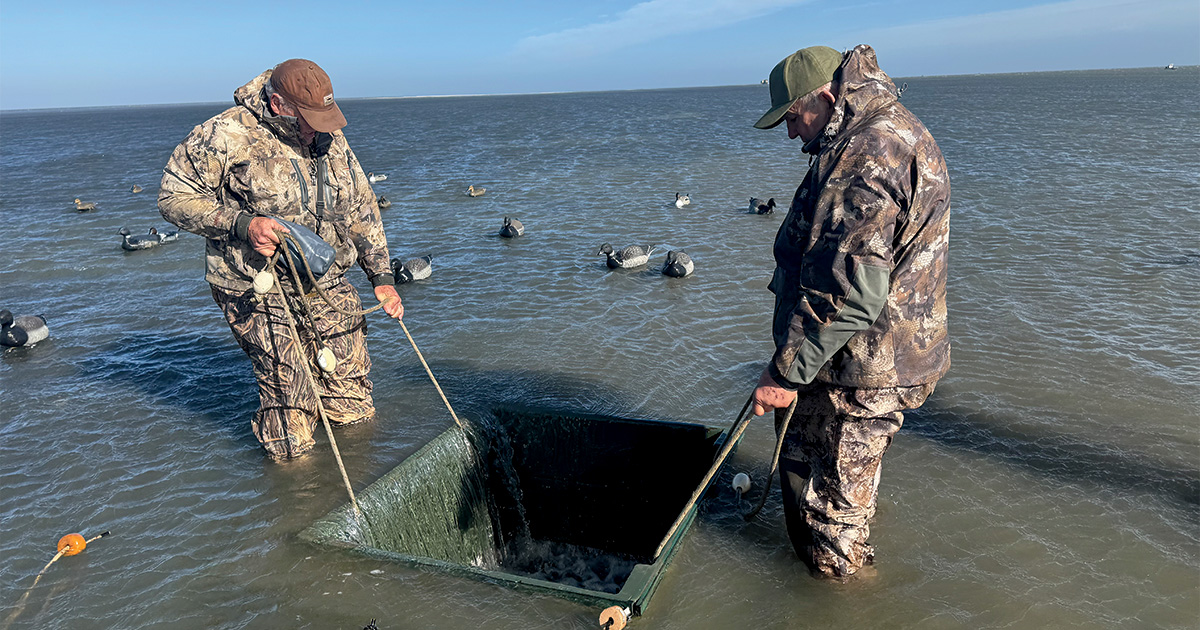
Unlike the sink boxes used by market hunters of old, curtain blinds, which are anchored to the bottom with heavy weights, remain legal for waterfowling in North Carolina.
“Pintails coming from your right shoulder,” Don says. “See ’em?”
I saw ’em. And they didn’t see us, which is the beauty of it all.
Few elements of waterfowling hold as much old-time allure as hunting from a sink box. The true sink boxes of the day were basically floating layout blinds. One or two shallow wooden cockpits were affixed to a wooden deck that was ringed with framed wing boards of cloth, which helped knock down waves and chop. Iron decoys weighted the contraption and allowed the gunners to raise or lower the sink box to match conditions in the sound. The blinds were used all along the Atlantic Coast but are best known from Chesapeake Bay and from Currituck and Pamlico Sounds in North Carolina.
The blinds were deadly in the extreme, and battery gunners slaughtered the ducks from them. On Currituck Sound, reported H.H. Brimley, at the time director of the North Carolina Museum of Natural Sciences, “bags of a hundred a day from a battery were not rare enough to get one’s name in the paper.” Blanton Saunders, a renowned duck guide and decoy maker, once told a reporter, “I’ve seen my granddaddy and daddy stand on the wing of that damned battery and the gun’d get so hot they’d have to souse the barrels overboard and the steam would fly out. They’d blow the water out of the barrels—peow! peow!—and then go to gunning again.”
One day in 1917, a Currituck market hunter named Van Griggs killed 518 ducks with his first 600 shots. Years ago, at the Currituck–Knotts Island ferry dock, I ran into a man named Walton Carter, who told me a story he had heard Griggs himself tell: Once a flight of redheads scudded in so low and fast that one bird sat down right in the battery blind. Griggs grabbed the duck, clamped it alive between his legs, and kept on shooting until he emptied his gun. Then he slid five more shells into the shotgun and told the terrified duck, “Old boy, I’m gonna give you a chance.” He let him go and emptied his gun without creasing the duck. In 1905, Van Griggs and his brother Russell killed 892 ruddy ducks in less than 10 hours, perhaps the highest one-day total ever posted in North Carolina.
No wonder the sink boxes were outlawed. And while no one wishes for a return to the market hunting days, there’s no question that those bloody decades were necessary to seed a conservation movement that continues to work for wildlife. And no denying the hold those old days and old ways still have on duck hunters today, especially along the Atlantic Coast.
In the curtain blind, I couldn’t help but think that Don and I were getting a taste, even if meager, of that storied era. The day before, the tide was so low we couldn’t reach the reef, and we hunted from a nearby stake blind. Redheads were more than willing, but pintails barely gave us a glance. But a vicious overnight wind had whipped Pamlico Sound into a frenzy, surf rolled over the reef, and the morning’s conditions could hardly have been better.
I peered over the lip of the blind, hardly two inches from the water’s surface. Pintails by the ones, twos, and 20s drifted in, wings set 10 feet from the wave tops. We raised the curtain a few inches to fend off the rising tide and hunkered down and tipped our hat brims low. I looked through the bobbing decoys, and there were pintails strafing the breakers and headed straight in, low and determined. “See ’em?” I asked Don. “Oh, yes,” he said. “How could you miss that?” As we rose to fire, the past and the present seemed to meet and mingle out there over the water, as it has for better than a century, just on the far side of a shotgun bead.

Share this photo


Ducks Unlimited uses cookies to enhance your browsing experience, optimize site functionality, analyze traffic, and deliver personalized advertising through third parties. By continuing to use this site, you agree to our use of cookies. View Privacy Policy