2025-2026 Ducks Unlimited Season in Review
Duck Populations, Habitat Conditions, Winter Weather, and Reports from the Field
Table of Contents
How Did Last Hunting Season Stack Up?
How did last season’s breeding habitat conditions and weather patterns shape waterfowl populations and your time in the blind? Ducks Unlimited’s 2025-2026 Season in Review breaks it all down.
- Breeding Population & Habitat Survey – A breakdown of last year’s duck numbers and habitat conditions
- Weather & Migration Trends – How key weather patterns influenced bird movement and hunting success
- Winter Distribution Changes – Research shows winter ranges for several duck species are shifting
- Field Reports – Firsthand accounts from hunters and biologists on the season’s challenges and successes
- Spring Breeding Outlook – What to expect heading into the next season
Continue below for a summary of the reports highlights.
Breeding Population & Habitat Survey
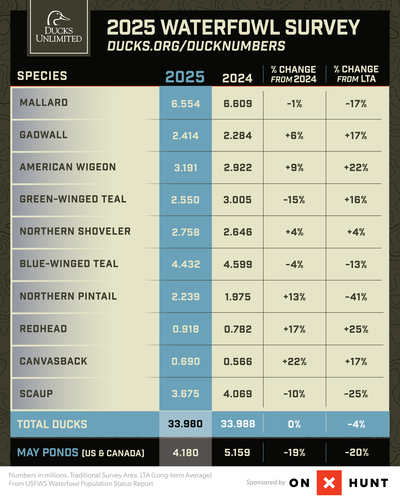
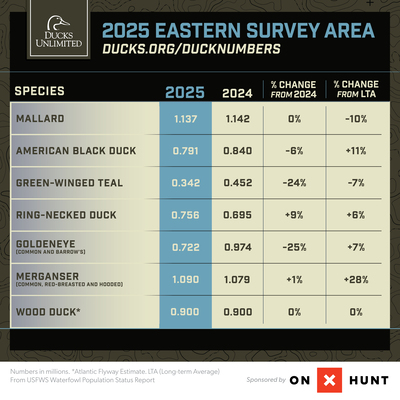
Summary: Despite an intensifying drought across the midcontinent, waterfowl demonstrated remarkable resilience in 2025. Total breeding ducks in the traditional survey area were estimated at 33.98 million, unchanged from 2024 but remaining 4 percent below the long-term average (LTA).
The most significant report from the 2025 survey was the dramatic decline in breeding habitat. The May pond estimate, an index of breeding habitat quality across the U.S. and Canadian prairies, fell to 4.18 million, representing a 19 percent decrease from 2024 and the lowest since 2004. The decline was steepest on the U.S. prairies, as pond estimates dropped 34 percent year-over-year to 1.6 million, 6 percent below the LTA.
In Prairie Canada, moisture levels were similarly poor. Although the region received above-average winter snowfall, much of that was absorbed by parched soils rather than filling wetland basins. The resulting estimate of 2.5 million ponds in Prairie Canada was 27 percent below the LTA.
Scattered rains in May and June offered localized improvements for late-nesting species, but they arrived too late to benefit early nesting mallards and pintails. For the second year in a row, early arriving birds encountered dry prairies, causing an overflight to more northern breeding areas in search of better conditions.
Despite these challenges, many species showed resilience. The continental mallard population was estimated at 6.55 million birds, roughly unchanged from 2024. Yet this figure was 17 percent below the LTA and marks a 44 percent decline from the record high of 2016. Pintails provided a notable surprise, as their population increased 13 percent from 2024. Diving ducks such as canvasbacks and redheads showed continued strength. Canvasbacks increased 22 percent over 2024 while redheads rose 17 percent, both above their LTA. Gadwall and northern shovelers remained strong relative to their LTA, while green-winged teal and scaup declined.
Weather & Migration Trends
Summary: Warm fall weather delayed migration across all flyways, and regional conditions strongly influenced hunting. The Pacific Flyway experienced scattered birds until January cold fronts improved action. Extreme dryness in the Central and Mississippi flyways limited natural flooding and created uneven habitat conditions. The Upper Midwest saw strong diver numbers, while mallard hunting depended on snow and cold. In the Atlantic Flyway, early drought improved with winter weather, and late‑January storms boosted hunting success.
Weather shaped nearly every aspect of the 2025–26 hunting season. Warm conditions persisted through early fall, delaying migration across all four flyways. In the Pacific Flyway, periodic floods and a prolonged fog inversion in California’s Central Valley dispersed birds across newly available habitats and limited consistent success. Hunters in the Pacific Northwest and Great Basin saw improved action only after January cold brought new birds into the region. The Central and Mississippi flyways were dominated by extreme dryness, particularly across the Mississippi Alluvial Valley, where Arkansas endured one of its driest seasons in more than a century. Natural flooding was nearly nonexistent, creating stark differences between hunters with pumping capacity and those without.
Diving duck hunters in the Upper Midwest fared well with strong numbers of redheads, scaup, and ringnecks, while mallard hunting was highly dependent on the timing of snow and cold fronts. A late-season freeze produced the best hunting of the year for those who found open water. In the Atlantic Flyway, early-season drought and warmth gave way to improved habitat and more consistent hunting as winter set in. Freezing conditions in northern states concentrated birds on deeper lakes, rivers, and coastal systems, and a series of late-January winter storms helped deliver a strong finish.
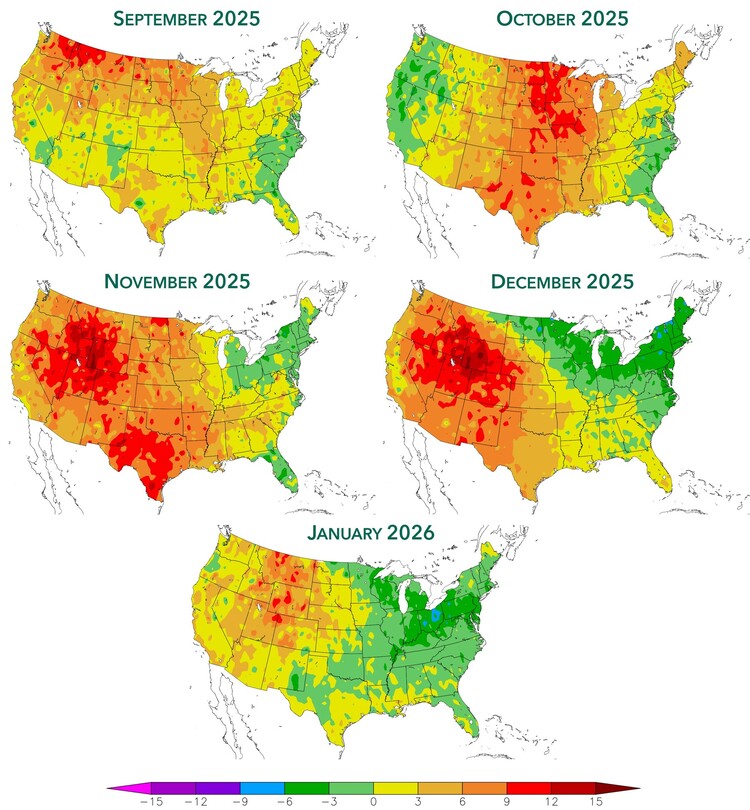
Average monthly temperature (°F) departure from normal for the contiguous U.S., Sep 2025–Jan 2026
Source: HPRCC
Download the Season in Review PDF for more detailed information.
Winter Distribution Changes
Summary: Recent analysis of six decades of band‑recovery data indicates that several duck species are undergoing measurable northward shifts in their winter distributions. Mallards and pintails show the most pronounced changes, with average winter recovery locations moving 35 to 240 miles north and contracting away from historic Gulf Coast wintering areas, while some populations have expanded their use of northern landscapes such as the Ohio River Valley.
New research adds scientific insight to what many DU volunteers and waterfowl hunters have observed in the field—winter distributions of several duck species are changing, although important nuances emerge from the data. Using 60 years of band recoveries, scientists studied the recovery locations of banded mallards, northern pintails, and blue-winged teal across the Central and Mississippi flyways to understand how their winter ranges have changed since the 1960s.
The study found northward shifts in where these species are wintering, especially in December and January. For mallards and pintails, average recovery locations moved 35 to 240 miles north depending on the subpopulation, with all showing contractions from historical wintering sites along the Gulf Coast. Mallards banded in prairie Canada and the Western Boreal Forest are now more likely to be recovered in the south-central Great Plains, yet recoveries of mallards banded in the U.S. prairies remain concentrated in Arkansas. In contrast, January recoveries of Great Lakes and Ontario mallards have shifted northeastward into the Ohio River Valley. At the same time, the breadth of winter ranges has expanded in the north, indicating ducks are utilizing landscapes more widely than in past decades.
Migration is a flexible strategy that allows waterfowl to access resources that vary across space and time and is largely responsible for their resilience in the face of mounting landscape pressures. This research is enhancing our understanding of how ducks adapt to dynamic environments and will support strategic planning for future conservation. Ongoing work aims to identify the drivers behind these shifts to ensure DU is proactive in protecting and restoring the habitats that waterfowl depend on across a changing continent.
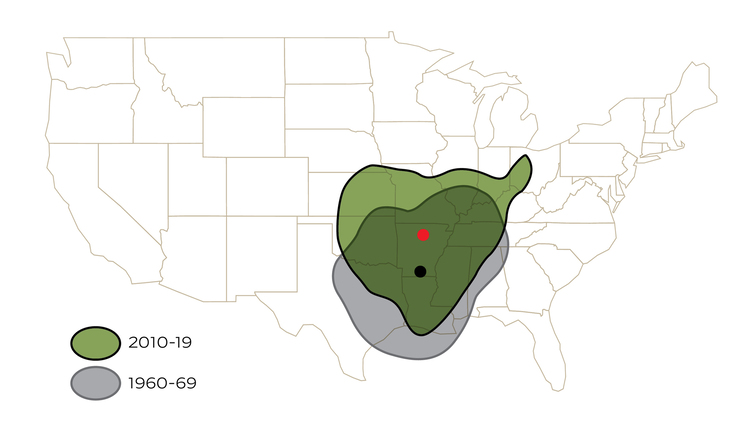
The overall distribution and average location of January recoveries for mallards banded in the U.S. Prairies shifted north between the 1960s and 2010s (black dot = centroid of overall recoveries in 1960s; red dot = centroid of overall recoveries in 2010s).
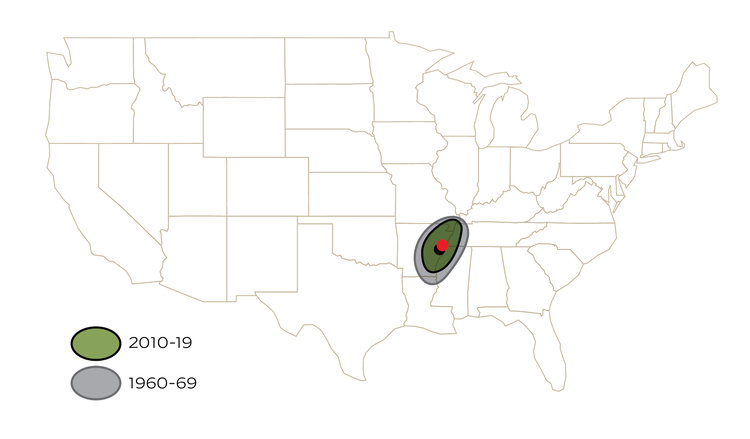
The core distribution of January recoveries for mallards banded in the U.S. Prairies changed little between the 1960s and 2010s, with the greatest concentration of recoveries remaining in Arkansas (black dot = centroid of core recoveries in 1960s; red dot = centroid of core recoveries in 2010s).
Flyway Field Reports
**The following summaries provide a snapshot of the prevailing messages that DU hunters, biologists, and partners heard throughout the 2025–26 season.
Pacific Flyway
Summary: Erratic weather and flooding scattered birds, resulting in inconsistent hunting across the West. Even with better winter conditions in January, hunter success stayed low—especially in California—because fog, storms, and abundant habitat kept birds scattered.
The 2025–26 season across the Pacific Flyway was marked by erratic weather and abrupt swings that challenged even the most seasoned hunters. In the Pacific Northwest, record-breaking rainfall paired with mild temperatures through December made for unpredictable success. Early-season rains replenished drought-stricken wetlands in Utah, but the abundance of habitat allowed birds to spread across newly flooded landscapes, leading to stale conditions and nocturnal feeding. Some hunters on the Great Salt Lake reported their worst year in memory, as warm weather had them fighting mosquitoes into December. Washington saw a similar slowdown as mild weather and ample food kept birds from pushing south. When winter finally arrived in January, hunters across the Great Basin and Pacific Northwest enjoyed strong finishes, with consistent shoots to close out the year. Farther south, California’s Central Valley experienced similar challenges, although the Klamath Basin enjoyed improved habitat conditions and avoided early freeze-ups. The Sacramento and San Joaquin Valleys contended with a month-long fog inversion and a series of atmospheric rivers, inundating floodways and dispersing birds across flooded rice and natural wetlands, leading to unpredictable bird movements and intermittent hunting success. Although pintail and green-winged teal numbers appeared lower than average in some managed habitats, a late-season push brought fresh birds, with some hunters reporting fantastic hunts during the final weeks. By most accounts, California hunters experienced a below-average season, as unfavorable flood events and mild temperatures limited opportunities for sustained success.
Central and Mississippi Flyways
Summary: Warm, stagnant conditions delayed migration, and severe drought in the South further limited duck movement. Mallards were scarce, but weather fronts sometimes brought strong hunts. Diving ducks were abundant, and success depended on local weather and hunter adaptability.
Conditions in the Central and Mississippi flyways were marked by a delayed migration and an intense drought across the South. Warm, stagnant conditions across the Upper Midwest and Great Lakes delayed migration and limited duck movement for much of the season. Many hunters reported a scarcity of mallards, though occasional bouts of favorable weather produced strong hunts. Reports from diving duck hunters were consistently good, with abundant redheads, scaup, and ringnecks on major lakes. When fronts aligned, birds moved and rewarded hunters who remained adaptable. Farther south in the mid-latitude and plains regions, weather-driven hunting success took shape.
Atlantic Flyway
Summary: Drought and warmth delayed migration in the northern Atlantic Flyway, with wetlands improving only late. Mid-Atlantic drought limited flooding and diver numbers, with many birds shifting to North Carolina. Farther south, drought restricted habitat, but cold fronts boosted duck numbers in Virginia and the Carolinas. Georgia and South Carolina saw strong starts and finishes, despite a midseason lull.
The northern Atlantic Flyway was challenged by early drought, warm fall, and delayed migration. Although October rains began to refill some wetlands, meaningful improvement came too late for the early season. As winter arrived, freezing temperatures locked up shallow wetlands and pushed birds to deeper lakes and major rivers, where late-season hunters found consistent success. Drought in the Mid-Atlantic made it difficult to flood managed wetlands, leading to patchy hunting and below-average dabbling duck numbers. Despite good stands of aquatic vegetation, diving duck numbers in Chesapeake Bay were disappointing. Many birds appeared to bypass traditional areas in favor of North Carolina’s coastal waters, where large rafts of redheads and scaup appeared by mid January. Farther south, early-season drought limited available habitat, but November and December cold fronts delivered strong numbers of ducks into Virginia and the Carolinas. Hunters in Georgia and South Carolina reported solid early success, followed by a warm weather lull before late January cold produced excellent hunting and a strong close across much of the Atlantic Flyway.
Looking Ahead to Next Season
The 2026 breeding season will be marked by its own set of challenges. Soil moisture has improved across portions of the U.S. prairies, but the Canadian prairies remain dry. Across the PPR, many wetland basins remain without water—the lingering effects of multi-year drought. Continuing the refrain from past years, significant late-winter snow and spring rain will be needed to spark a meaningful recovery. Drought conditions have expanded across the Boreal Forest, renewing concerns for these critical breeding landscapes. Snowpack levels across the West are below average, and additional winter storms are urgently needed to support spring and summer runoff that fuels breeding habitats. With limited production from this past year, biologists widely expect breeding duck populations to remain below average in 2026. Spring weather will ultimately determine wetland availability, nesting success, and the production that shapes next year’s fall flight, but managers are already viewing the coming year with caution.