Reforesting the Flyway
DU continues to build on its successful efforts to restore bottomland hardwood forests
DU continues to build on its successful efforts to restore bottomland hardwood forests


By Jennifer Boudart
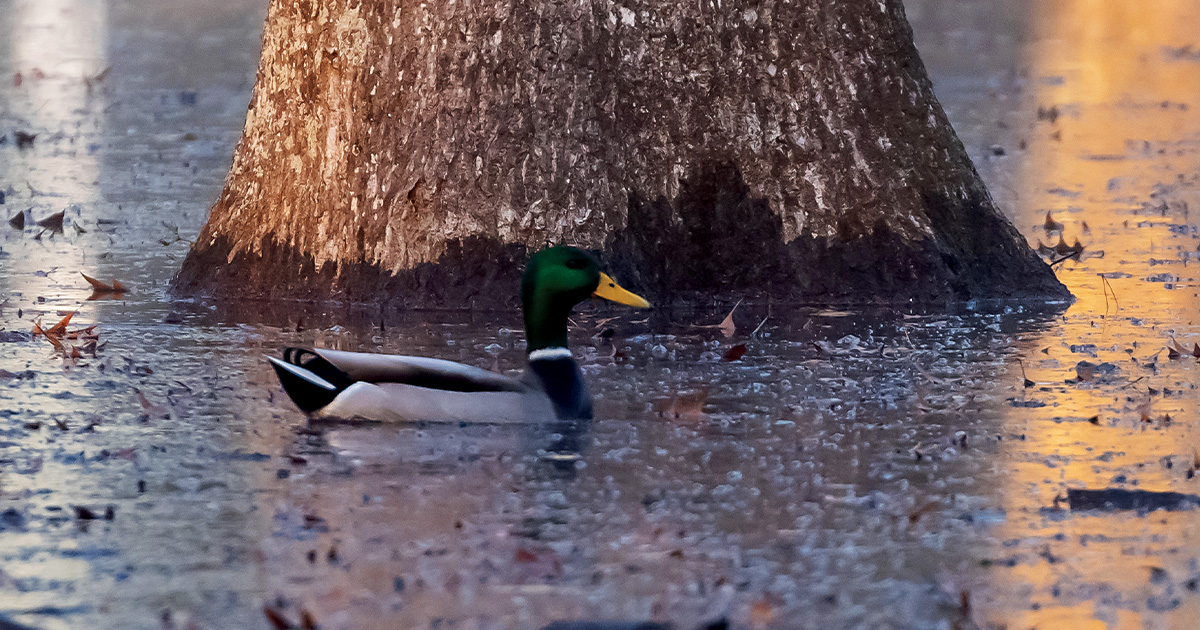
The Mississippi Alluvial Valley is the continent's most important wintering area for mallards, which rely heavily on seasonally flooded bottomland hardwood forests for feeding and resting.
Last year, the USDA’s Natural Resources Conservation Service (NRCS) reached a significant conservation milestone for a component of its Agricultural Conservation Easement Program (ACEP). The NRCS Wetland Reserve Easements (WRE) program—which funds work nationwide to restore, enhance, and protect wetlands and associated habitats on private lands—surpassed the 1-million-acre mark for bottomland hardwood reforestation across Arkansas, Mississippi, and Louisiana. These states encompass the heart of the lower Mississippi Alluvial Valley (MAV), one of the most important waterfowl wintering areas in North America.
Each year, at least 5 million waterfowl flock to the MAV. Many of these birds seek food, shelter, and thermal refuge in seasonally flooded bottomland hardwood forests along the Mississippi River and its tributaries. Unfortunately, some 80 percent of the original lowland forests within the MAV have been cleared, primarily for agriculture, and natural flooding in the region has been reduced by as much as 90 percent. To mitigate these losses, the NRCS has been working with private landowners to restore bottomland hardwood tree species and natural hydrology on lands voluntarily enrolled in the WRE program.
When the NRCS announced that the 1-million-acre milestone had been achieved, the agency recognized Ducks Unlimited as one of the key partners who helped make it possible. That’s not surprising, given that the MAV is one of DU’s highest-priority landscapes, and DU’s work with ACEP dates back to the mid-1990s, just a few years after the program was established as part of the 1990 Farm Bill (when it was called the Wetland Reserve Program). “DU didn’t plant every one of those million acres, but we planted the majority of them,” says Jerry Holden, DU senior director of operations in the Southern Region.
Holden says DU’s work in the MAV over the last three decades has focused on two fronts. The first is protecting existing tracts of bottomland hardwood trees on private lands. Work on that front has been accomplished in large part through DU’s traditional easement program, and Holden notes that DU has permanently protected roughly 188,000 acres on 163 different conservation easements in the region. The second front, which has gained importance over the years, has been to put trees back on the landscape.
An assessment conducted by DU and the Lower Mississippi Valley Joint Venture found that about 6 million acres of the original 28 million acres of bottomland hardwood forest that once existed in the region are suitable for reforestation. “These are areas where land use and land capacity are farthest apart—where the presence of very hydric soils makes it difficult to grow crops,” Holden explains. “If those acres are planted in trees instead of row crops, everyone can benefit, including the producers. There’s an old phrase, ‘farm the best and restore the rest,’ and that’s still pretty apt today.”
Much of DU’s reforestation work in the MAV has been delivered in partnership with the NRCS through the WRE program, with DU overseeing tree planting and the installation of water-control infrastructure to manage water levels in a way that protects young trees as they mature. Holden praises the success of this partnership while acknowledging that there is more work to do. “The scale of DU’s mission is fairly audacious. We’ve needed a way to go faster, to do reforestation on an even larger scale. So we have launched the Flyway Forests program to help expand our conservation footprint.”
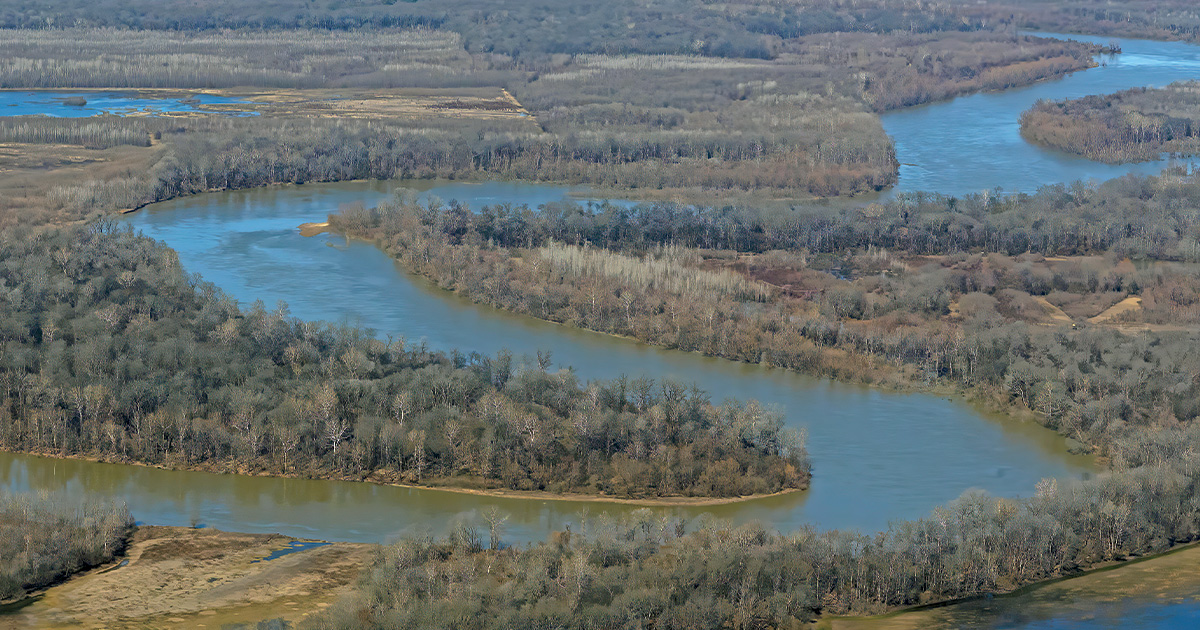
Flyway Forests is a DU pilot program that uses carbon credits as a new source of revenue to help replant forests on private lands.
Holden says that Flyway Forests is an innovative pilot program that taps into carbon credits as a new source of revenue to help replant forests on private lands in the MAV. DU purchases voluntary easements from landowners and pays them for the rights to prepare the land for reforestation, plant appropriate tree species, and manage and monitor their growth through field verification every five years for a 40-year period. The data will be used to generate carbon credits that will ultimately be released for sale on one of several carbon registry platforms. Proceeds from those sales will fund ongoing payments to landowners in the future. Land & Water Corp, a Colorado-based land, equipment, and services company with a long history of supporting DU’s conservation efforts, is currently funding the majority of the program as well as providing operational and administrative support.
“We’re entering phase four of the program, and we expect to enroll at least 3,000 acres this year,” says DU National Carbon Program Lead Lauren Alleman. “That’s about twice the annual volume we’ve done in previous years.” Alleman reports that 15 landowners are currently enrolled in the program, and they have a range of incentives for participating. “Some of them are thinking about succession planning—they’re getting out of farming and don’t have kids who are interested. They have a connection to the land and would rather see it restored back to habitat. One landowner has a large hunting club. Another is looking at balancing production agriculture, and he enrolled less-productive acres along waterways that wouldn’t be producing any revenue to maximize revenue streams on that active farm.”
While the program’s first carbon credits won’t be released until 2030, Alleman says DU is already generating interest in the carbon market because there is strong demand for “removal credits,” which include those generated through tree planting. She believes DU’s carbon credits will be highly attractive once they are released. “People are being selective about finding very high-quality projects that have lots of transparency and demonstrate very high standards, and I honestly think that’s the strength of our program.”
Flyway Forests has really hit its stride, Alleman notes. She’s optimistic about its future. “We have a really great team, our funding partner is great, and we know how to identify great sites and have great partners in our landowners. We also have the legacy of DU’s successful partnership with the NRCS via the WRE program and have the right machinery to utilize. I’m excited to see continuing commitment to growing the program by doubling or even tripling the number of acres we do every year. We hope we can get to at least 10,000 acres and possibly even double that by 2030.”
That goal will be easier to achieve thanks to a recent $10 million grant DU received from the US Forest Service. The grant was awarded through its Forest Landowner Support Program, which helps make emerging environmental markets accessible to private forest landowners. The bulk of the grant is earmarked for Flyway Forests, says Alleman. Approximately $1 million is going toward marketing and enrollment support from Trust in Food—a Farm Journal subsidiary—and Landoption, a startup that helps landowners find eligible conservation programs. Roughly $6 million is being used to help cover staffing and other costs of delivering the program.
Whether it’s Flyway Forests, the WRE program, or any of its other reforestation efforts, DU understands that land protection in the MAV is all about playing the long game. Trees take a long time to mature, to be able to withstand flooding, and to provide optimal waterfowl habitat. As Holden explains, “We aren’t working for our generation—we don’t get to see the benefit, because trees take 70 years to mature. But we are contributing to the long-term protection of bottomland hardwood forests for future generations and ensuring sustainability of the ecosystems that waterfowl depend on. And that is DU’s ultimate objective—whether it’s in the MAV or on the prairies or along the coast.”

Share this photo


Ducks Unlimited uses cookies to enhance your browsing experience, optimize site functionality, analyze traffic, and deliver personalized advertising through third parties. By continuing to use this site, you agree to our use of cookies. View Privacy Policy