Five Duck Calls to Master this Off-Season
These five must‑know duck calls, paired with a little practice, could help boost your success this fall
These five must‑know duck calls, paired with a little practice, could help boost your success this fall





The basic quack is the foundation of effective duck calling. Mastering this single call opens the door to more advanced calls and better results in the field.
Few off-season projects will pay greater dividends and boost confidence in the blind than investing time in becoming a better duck caller. The following is a look at five essential duck calls that are worthy of your attention. With some practice, they may help you put more birds over the decoys this fall.
Mastering the basic quack is the most important step toward building control over your call and developing your own duck vocabulary. As world champion caller Jim Ronquest emphasizes, focusing on the fundamentals matters more than trying to replicate the complex combinations of sounds that you might hear on Instagram or on the competition stage.
“Most everything you learn to do on a duck call is based on that single quack,” he says. Using the syllable of your choice—hut or whit—focus on producing just one quack until it becomes second nature. By perfecting the basics, you start to develop muscle memory and learn to control your diaphragm, airflow, and tone so that your quack sounds authentic. “Once those basic sounds come easily, you’ll call every duck that wants to be called,” Ronquest says.
Ronquest also stresses that calling isn’t about making noise for noise’s sake. It’s about reading ducks and adjusting to how they are reacting to calling in the field.
With the basic quack in your toolbox, it’s time to turn your attention to the five-note greeting call, which will become one of your most impactful tools.
“It’s another really important building block for so much of what you’ll do as a caller,” explains veteran guide and hunter Ben Fujan. “Start by stringing two quacks together, then progress to five descending quacks—some callers think of steps on
a ladder or even the song ‘Three Blind Mice’ when practicing. When you can consistently blow that sequence, then it’s time to work on adjusting the volume, tempo, rhythm, and cadence to use at different times in the field and in response to how the birds are reacting.”
By drawing the notes out and adding volume, you have the components of a hail call that can be used to grab the attention of ducks at a distance or over big water. Adding speed and urgency turns the greeting call into a comeback call, or you can soften and shorten the sequence for birds that are working close to the decoys.
When practicing, Fujan suggests finding a group of live birds or listening to recordings found online for guidance. “One of my favorite things is to just listen to how many different versions of that greeting call I’ll hear,” Fujan says. “The fast, the slow, the big boss hen just nailing those five raspy quacks. It’s such a fun way to get ideas for practicing and building a calling vocabulary that I can use while hunting.”
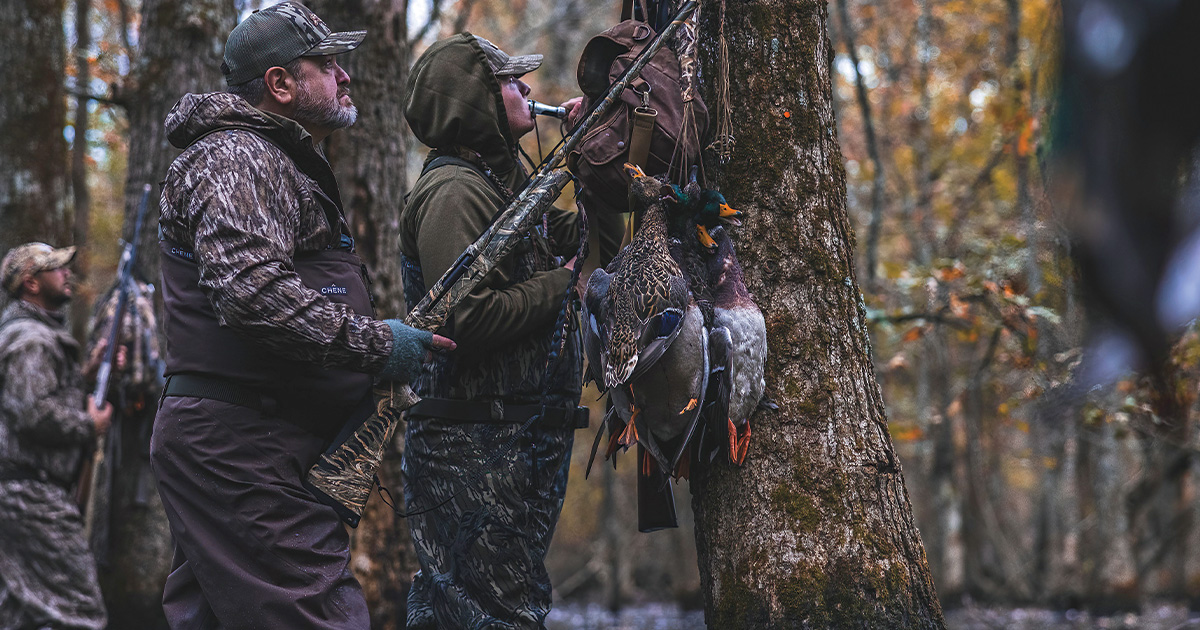
By drawing out the notes of a five‑note greeting call and adding controlled volume, hunters can create a hail call to grab the attention of high-flying ducks.
There are two different styles of feeding calls that hunters can learn how to blow, and both are effective in the field. The first is the rolling style of feed call that is produced by blowing a dugga dugga, tick-a tick-a, or similar sound into the call. A rolling feed call (also called a feeding chuckle) can be more difficult to learn. Start slowly with a single dugga (or other two-syllable sound), then gradually increase the speed until you can string multiple syllables together. The feeding chuckle is often used to add excitement while birds are working close to the decoys.
Another style of feed call uses what veteran guide and Banded pro-staffer Rusty Creasey calls “single cuts” to produce the short, almost percussive sounds that mallards make while feeding. To do this, simply use the syllable ta while blowing bursts of air into the call. “Start with one ta, then two, and so on. It doesn’t require as much work with your tongue as a rolling-style feed call, but it sure sounds realistic and it is extremely effective,” Creasey says. “My favorite way to use a single-cut feed call is when the ducks are finishing. I change the sound slightly to a ka, and you’ll hear on my videos that the next thing you’ll hear after ka, ka, ka is me calling the shot. It’s a great confidence call and a great way to help finish birds in the decoys.”
Creasey will also use a single-cut feed call on ducks when they are swinging the decoys, calling to them on the corners just like he normally would with a five-note greeting call or comeback call. This is especially effective late in the season, when ducks tend to get shy of traditional calling methods.
The final calls on this list involve the use of a whistle, which may be one of the more underrated tools that a duck caller can have in the field. Unlike the traditional duck call, which produces the sounds of a mallard, a whistle is used to produce higher-pitched peeps, trills, and other sounds that are specific to different species of ducks, including pintails and wigeon. Having a whistle on your lanyard helps expand your duck vocabulary and will help pull in ducks that might otherwise ignore a typical quack.
California guide and hunter Ryley Haugh uses a standard duck whistle to make the sound of a pintail by covering the main air exit with a finger, placing the mouthpiece of the whistle to his lips (with his front teeth resting on the mouthpiece), and fluttering or rolling his tongue while blowing gently. “That combination produces that unmistakable long, clear, trilling peep of the pintail,” Haugh says. “To adjust the pitch and volume of the call, I change just how much of the air exit hole is covered by my finger.”
The raspy whistle of a wigeon is another useful call to master, and it is produced by saying who-wee-who into a duck whistle. You use warm air from your diaphragm to produce the quack or greeting call of a mallard, but you use breathy, cold air from just behind your front teeth to call to a wigeon.
In addition to pintails and wigeon, Haugh says a duck whistle can be used to produce the sounds of wood ducks, drake mallards, and green-winged teal, and it is a great tool to help introduce calling to a young or inexperienced hunter. “Most importantly, using a whistle can help set you apart from other hunters in the area and make your decoy spread stand out to ducks passing by,” Haugh says.

Share this photo


Ducks Unlimited uses cookies to enhance your browsing experience, optimize site functionality, analyze traffic, and deliver personalized advertising through third parties. By continuing to use this site, you agree to our use of cookies. View Privacy Policy