Train Like a Pro
Four of the world’s most accomplished retriever trainers share their secrets
Four of the world’s most accomplished retriever trainers share their secrets

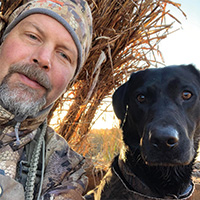


A good retriever is born with many of the instincts and physical traits needed to perform his duties, but honing those attributes, practicing a variety of new skills, and teaching him the rules of the waterfowling game will keep a trainer busy for years. Those of us who train our own retrievers understand how rewarding and how much fun the process can be. We also realize that there will be challenges along the way. And when you hit a stumbling block, it’s sometimes helpful to seek out the advice of a professional.
We spoke with four trainers at the top of their game and asked them for their thoughts on some of the most important and troubling facets of the training process—everything from acquiring the right puppy to taking him hunting for the first time. If you ever find yourself stuck, frustrated, or just plain clueless about an important element of your retriever’s training, these pros are here to help.

You would be hard-pressed to find a professional who doesn’t agree that obedience is the bedrock of retriever training. It’s the all-important foundation that supports every skill a dog needs to become a dependable, well-mannered, and pleasurable hunting companion. So it’s important to take a thoughtful approach to obedience and to start the process when your pup is young.
“When we take an eight-week-old dog into our backgrounding program, 95 percent of our focus is on obedience, steadiness, and calmness,” Klotsche says. It is in this early stage of training that a pup learns basic skills like sit, heel, and come, but this is also where pro trainers begin establishing behaviors, like patience and calmness, that will eventually pay dividends in the field or marsh. “The retrieving will come, but not until the fundamentals are down pat. All of these very basic skills quickly become entrenched habits that later become transferable to the field. It is important to realize that everything a puppy learns in their first six months they will never forget—good or bad.”

With her experience in breeding and training Labs in the United Kingdom, Laura Hill brings a unique perspective to the discussion. She says her aim is to make training enjoyable and beneficial at every level, especially when dealing with impressionable puppies. “I don’t really like the term ‘obedience,’” she notes, “as it implies that if your pup is not doing what you are asking then he is being disobedient, when in fact it is more usually the case that the pup doesn’t understand what he is being asked to do in that context. I want my dogs to work with me to get the rewards that they want for the behavior that we need to get the job done.
“I usually work on the basics indoors with the pup, then move into the garden and then eventually start to generalize in other locations,” Hill continues, “ensuring that the dog is completely conditioned to the cues that I am using in all situations. I reward the behaviors I want, and young pups quickly catch on to what they need to do to get the rewards. It’s easier to get these foundations in early while the pup is still young, rather than when he is older and has been allowed to develop unwanted behavior patterns.”
A steady retriever is a safe retriever, never leaving his assigned place until the shooting is done and he’s been sent to do his work. A steady retriever is also a pleasure to hunt with, exhibiting the manners and control that are the marks of a truly finished gundog. But steadiness isn’t something you teach once. It’s the result of a training philosophy that is reinforced throughout the dog’s lifetime.
“Most people think that steadiness starts at about six months,” says Tom Dokken, one of the retriever world’s most recognizable names. “But for us it starts when you pick up that seven- to eight-week-old puppy for the first time. When you pick him up and he struggles to get down, put some pressure on him with a gentle but firm hug. As soon as he relaxes, put him down. The puppy begins to learn that if he wants something, he has to wait for it. Compliance gets him what he wants. And the sooner he relaxes, the sooner he will get what he wants.”
Dokken follows this philosophy as the puppy gets older, and he finds ways to teach and practice on a daily basis, making the pup sit and wait before going in or out of a door, before eating, and, eventually, before retrieving a thrown dummy or bird. “Teach, repeat, and reinforce” is Dokken’s mantra throughout the dog’s training, and he stresses that these principles must be done in this order. Teach so that the dog understands what you want him to do. Repeat to practice and perfect the skill. Reinforce if the dog doesn’t comply.

Hill believes steadiness is a “state of mind, not a state of limbs.” She explains: “If we can teach our dogs to manage their own impulses, rather than us suppressing them and making them do things, then this will lead to a dog that is much better equipped to deal with exciting situations. What I mean by this is that I aim for the dog to regulate his behavior himself to get the reward.
“For example, there are two ways to manage kennel or crate exits,” she says. “We can tell the dog to sit, sit, sit while we open the door, so we are forcing a behavior on him when he would really rather not do that. Or we can open the door, saying nothing and just observing. If the dog goes to rush out, just quickly close the door to prevent it. As you repeat this process, the dog learns that rushing toward the door makes the door shut, so eventually he works out that sitting down, or staying still, means the door stays open for him. Praise this behavior and give a release cue to ask him to come through the door. In this way, the dog has learned to manage his own arousal level to get the reward.”
Klotsche says that denials are an important part of the process to build a steady retriever. “Once our puppies have learned to sit patiently on a training platform, we introduce denials,” he says. “With the pup sitting on the platform, we are tossing bumpers or tennis balls and blowing duck calls. Eventually, we move the denials closer and closer to the dog. By the time our puppies are four months old, they have easily seen more than 500 denials and have learned that not everything that goes up is theirs. It is important to realize that this process actually builds prey drive. They so badly want to get every one of them, and on the rare occasions that we mix in a retrieve they are so excited to go get it.”
Gone are the days when hunting dogs lived in outside kennels and were never allowed in the house. Today, trainers understand that a dog learns best when he is with you and when he is exposed to as many new and different situations as possible.
“The more time you spend with your dog, the better your dog is going to be,” Trott says. “The best hunting dogs are house dogs. They’re part of the family. The same goes for field trial dogs. You should crate-train your puppy, but if you leave him in a crate all the time, he won’t learn anything. When you spend lots of time with him—that’s where he learns the good behaviors and manners.”
Klotsche says that it is important to wait until your pup is fully vaccinated (about 16 weeks) before taking him out to do a lot of socialization. “After that,” he says, “we strongly encourage socialization outings for puppies to get familiar with a wide variety of environments. We want our puppies to be exposed to as many sights and sounds as they can. The other thing that we do is lots of group training. While one puppy is being formally trained, two more are sitting on ‘place’ and patiently waiting their turn.”

This is an essential element of training for any gundog, and one that should be approached with caution. Gun-shyness is almost always the result of an improper or rushed approach. Success depends on building a positive association between noises and retrieving, introducing actual gunfire gradually, and carefully observing your dog for any signs of discomfort.
Trott explains that this process can be easy if you first build a strong desire to retrieve and then add in gunfire at a distance. “They associate the noise with the retrieve, which is something they love,” he says, noting that it’s often wise to wait a while before taking on this crucial step in a gundog’s education. “We don’t worry about gun training until the dog is older, confident, and has lots of retrieving desire.”
Dokken agrees that a cautious and thoughtful approach is essential. “Wait until he’s about five months old and make sure he’s really interested and excited about retrieving. Have a helper go out about 20 yards, clap his hands, and throw a dummy. That’s not much noise, but it’s the first step in getting the dog to associate a noise with the retrieve. Eventually, move to 30 yards and a .22 blank. Always watch the reaction of the puppy very closely. At the sound of the gun, look to see if he blinks or turns his head away. If you see these or any other signs that the noise is making the pup uncomfortable, move the gun farther away and work your way back in. Gradually move to a .410 shotgun, then a 20-gauge, and then a 12-gauge.”

This is where it all comes together. Few things are more memorable than your dog’s first retrieve, especially when you’ve devoted countless hours to getting him ready. It’s a special day, so ensure that you and your retriever are ready.
“Make sure the dog understands all of the fundamentals he needs before taking him hunting,” Dokken says. “Find ways to teach and practice skills on a daily basis in the house or backyard. For example, one of the ways you can help a very young pup learn to hunt dead is to move his food bowl to different parts of the house when he isn’t looking, then sit him and send him to find it.”
Trott advises hunters to simulate the hunting environment as much as possible in a training situation, but he says retrievers will still need time in the duck blind to put it all together. “I don’t care how well trained they are. They have to learn to hunt by hunting. The more birds they retrieve, the better hunter they will be,” he says.
When it’s time for that first hunt, make sure it’s a positive experience, Dokken adds. “Take a good shooter along to do the shooting while you handle the dog,” he says. “The first hunt should last no longer than about a half-hour. Bring some dummies, so that if you don’t shoot any birds, your retriever can still get some work in.”
Klotsche suggests waiting until the pup is at least 18 months old and really steady on the basics before hunting. “For first hunts, you can have the dog on lead in the blind and release him only on the birds that you want,” he says. “If you fold a bird in the middle of your decoy spread and it is laying belly-up, that would be a good bird to send your dog on. On the other hand, if you sail a bird and it is still alive 150 yards out in the cattails, this is not the scenario where you want to send your dog.”

“Without a solid recall and delivery to hand you don’t have a retrieve at all,” Hill explains. “You just have a chase!” A well-trained retriever fetches the bird, returns to his master, and holds the bird until instructed to release it. There are several different methods for teaching this valuable skill, but the desired behavior is the same.
“Requirements for competition in the UK are different than in the US, and where we want our dogs positioned for delivery differs too,” Hill continues. “But what we can agree on is that we want that bird delivered quickly and efficiently back to hand, so that it can be dispatched humanely if necessary. I usually ensure that the dog has a strong desire to retrieve first before formalizing the delivery part. So, with a young pup it would be enough for me if they chased out after a retrieve with enthusiasm and came running back to me with the dummy, delivering themselves and the item roughly in my vicinity. Once this is established, and teething is definitely out of the way, I then work on some static ‘hold’ and ‘dead’ work indoors, getting the dog to understand the concept of holding the retrieve and then also being prepared to release it on cue. Finally, when this is solid, I combine the two things back out in the field again for a complete retrieve.”

Share this photo


Ducks Unlimited uses cookies to enhance your browsing experience, optimize site functionality, analyze traffic, and deliver personalized advertising through third parties. By continuing to use this site, you agree to our use of cookies. View Privacy Policy